
How much to feed a Poodle: from Toy to Standard Poodle
How much a Poodle eats depends mainly on its size. An adult, neutered Miniature Poodle weighing 6 kg needs about 430 kcal a day with normal exercise – roughly 120 g of dry food or 430 g of wet food. A 2.5 kg Toy Poodle gets by on about 225 kcal (65 g), while a 25 kg Standard Poodle needs around 1,250 kcal (345 g). Always base your calculation on the weight your Poodle has at a good body shape.
Updated on
Adult weight
- Toy Poodle (24–28 cm):
- approx. 2–3 kg
- Miniature Poodle (28–35 cm):
- approx. 4.5–7 kg
- Medium Poodle (35–45 cm):
- no guideline
- Standard Poodle (45–60 cm):
- approx. 18–32 kg
Sizes according to FCI standard no. 172, weights approximated from the American Kennel Club figures for the Toy, Miniature and Standard Poodle. No major breed club gives a weight for the Medium Poodle.
Activity type
Four sizes, one standard: from the Toy Poodle under 28 cm to the Standard Poodle at up to 60 cm – the rations vary just as widely.
Breed watch points
Size, teeth, bloat
Calculate how much to feed your Poodle
Enter the weight and choose the type of food – the result updates instantly.
Leave empty = typical value of 360 kcal (usually 330–400 kcal/100 g). If the pack says MJ/kg, calculate MJ/kg × 23.9.
Result
120 g
Dry food per day
≈ 430 kcal · 2 meals of 60 g
 Get it worked out for your dogRecipes with grams per ingredient in the DoggoMeal app
- Range per day
- 105–130 g
- Meals
- 2 per day
- Per meal
- 60 g
- Energy
- 430 kcal (385–470)
How the figure is calculated
Resting energy requirement 70 × 6 kg^0.75 ≈ 268 kcal × factor 1.6 ≈ 430 kcal per day.
430 kcal ÷ 360 kcal per 100 g (typical dry food) × 100 ≈ 120 g.
- A starting point – check the weight every 1–2 weeks and adjust the amount in small steps. Treats count too.
Poodle feeding chart by weight and activity
Adult, neutered dog. Dry food with 360 kcal, wet food with 100 kcal per 100 g.
| Activity | kcalper day | Dryg per day | Wetg per day |
|---|---|---|---|
| 2.5 kg | |||
| Calm | 195 | 55 | 195 |
| Normal | 225 | 65 | 225 |
| Active | 280 | 80 | 280 |
| 6 kg | |||
| Calm | 375 | 105 | 375 |
| Normal | 430 | 120 | 430 |
| Active | 535 | 150 | 535 |
| 25 kg | |||
| Calm | 1,095 | 305 | 1,095 |
| Normal | 1,250 | 345 | 1,250 |
| Active | 1,565 | 435 | 1,565 |
How it is calculated: Calm = factor 1.4, Normal = 1.6 (neutered, 1–2 hours of walks), Active = 2.0. Entire (unneutered) dogs with normal exercise come out about 12 per cent higher (factor 1.8).
Example for 6 kg: resting energy requirement 70 × 6 kg^0.75 ≈ 268 kcal × factor 1.6 = 430 kcal a day, divided by 360 kcal per 100 g = 120 g of dry food. If your pack states a different value, enter it in the calculator above.
Four sizes, four rations
The FCI standard recognises four Poodle sizes: Toy Poodle up to 28 cm, Miniature Poodle up to 35 cm, Medium Poodle up to 45 cm and Standard Poodle up to 60 cm at the withers. It does not set a weight. The American Kennel Club figures for comparable sizes are about 2 to 3 kg (Toy), 4.5 to 7 kg (Miniature) and 18 to 32 kg (Standard). There is no official figure for the Medium Poodle – so simply weigh your Poodle and base the calculation on its weight at a good body shape.
Per kilo, a small Poodle needs considerably more energy: a 2.5 kg Toy Poodle needs about 90 kcal per kilo, a 25 kg Standard Poodle about 50. A 10 kg Medium Poodle with normal exercise would need about 630 kcal (175 g of dry food). Rules of thumb based on a percentage of body weight therefore do not work well for any of the four Poodles.
Small Poodles: teeth. Large Poodles: stomach and adrenal glands
In the Toy Poodle, teeth are the big issue: in a VetCompass study of 22,333 dogs in British veterinary practices, it had the highest odds of periodontal disease of all breeds, almost four times as high as in crossbreeds; 26 per cent of Toy Poodles were affected. According to the MSD Veterinary Manual, dry food alone does not reliably protect against plaque and tartar – toothbrushing and regular check-ups matter more.
The MSD Veterinary Manual lists the Standard Poodle among the breeds with an increased risk of bloat (gastric dilatation-volvulus). Risk factors include feeding only one meal a day, feeding only dry food and eating quickly. In another VetCompass study, large Poodles (all Poodles over 38 cm under the British classification) had around 51 times the odds of Addison’s disease, an underactive adrenal cortex, compared with crossbreeds – about one dog in 50 was affected. The disease often shows only as recurring vomiting, diarrhoea, loss of appetite and tiredness, and is therefore easily overlooked.
- Toy and Miniature Poodles: brush the teeth daily if possible and count chews towards the daily ration.
- Standard Poodles: spread the daily amount over at least two meals, with rest before and after eating.
- Don’t just treat recurring vomiting or diarrhoea by changing the food – have it checked by a vet.
Poodle puppies: very different depending on size
Toy Poodle puppies are among the very small puppies that, according to the American Kennel Club, can develop low blood sugar between meals – especially when they play hard, get cold or are stressed. Small, frequent meals help: up to about three months four a day, after that three.
Standard Poodle males reach the weight of large breeds at up to 32 kg. According to an article in the Canadian Veterinary Journal, problems caused by growing too fast mainly occur in puppies that weigh over 23 kg as adults. So feed a Standard Poodle puppy in a controlled way and weigh it regularly instead of topping up according to appetite.
The puppy feeding calculator works out the exact amount by age and current weight.
Recipes with grams per ingredient – for your Poodle
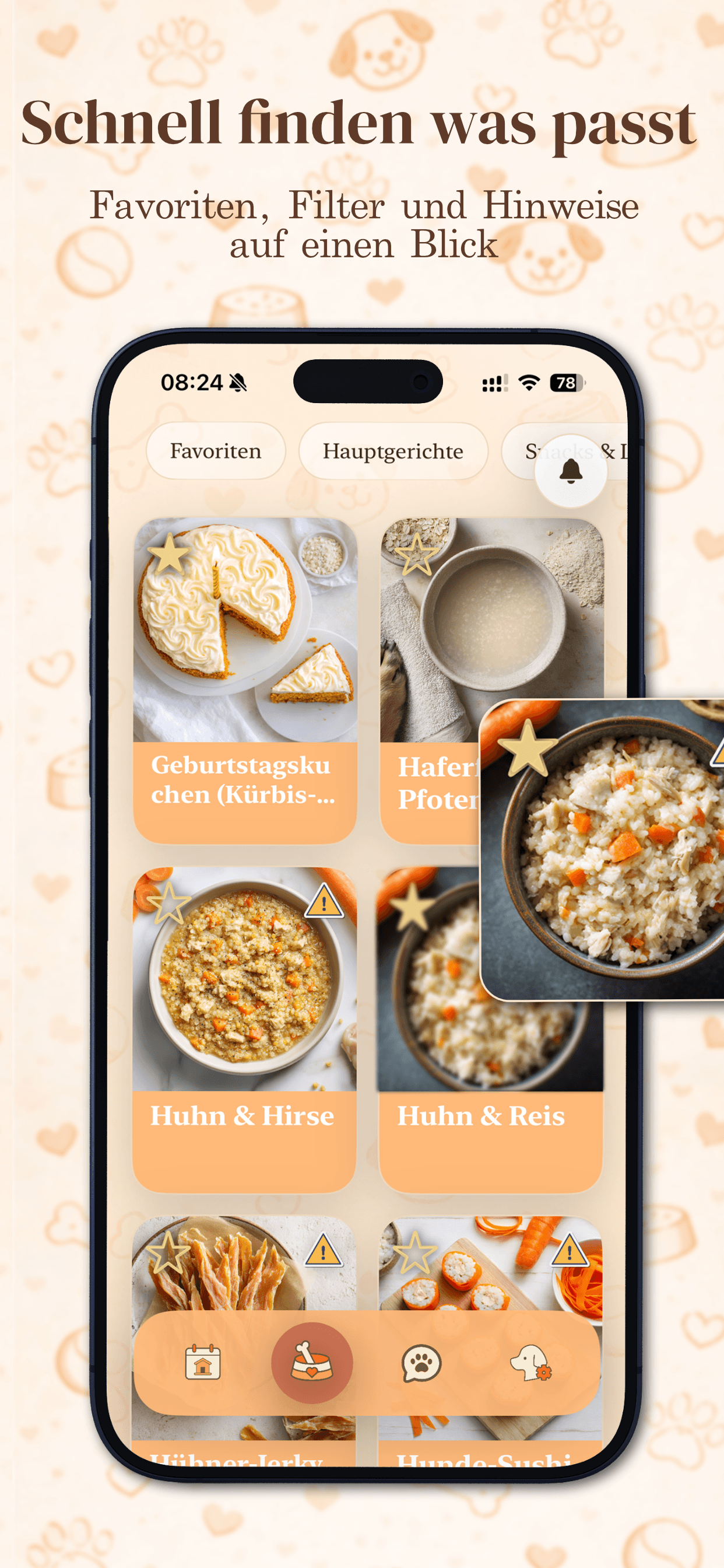
In the DoggoMeal app you create a profile for your Poodle – with weight, age, activity and allergies. From this, the app calculates recipes with grams per ingredient, daily calories and portions.
- Dog profile
- Recipes with gram amounts
- Allergy warnings
- Cooking with video
Free · no subscription · every feature included
Common questions about feeding your Poodle
How much food does a Poodle need a day?
That depends on its size. Neutered and with normal exercise, a 2.5 kg Toy Poodle needs about 225 kcal, a 6 kg Miniature Poodle about 430 kcal and a 25 kg Standard Poodle about 1,250 kcal a day. In dry food with 360 kcal per 100 g, that is roughly 65 g, 120 g and 345 g.
How heavy does a Poodle get?
The FCI standard only sets sizes. According to American figures, Toy Poodles weigh about 2 to 3 kg, Miniature Poodles 4.5 to 7 kg and Standard Poodles 18 to 32 kg, males more than females. There is no official figure for the Medium Poodle (35 to 45 cm).
How much food does a Medium Poodle need?
Weigh your Medium Poodle and enter its weight in the calculator. At 10 kg, neutered and with normal exercise, it needs about 630 kcal a day, roughly 175 g of dry food; at 14 kg it is about 810 kcal.
How often should a Standard Poodle eat?
At least twice a day. According to the MSD Veterinary Manual, the Standard Poodle is one of the breeds with an increased risk of bloat, and a single meal a day is considered a risk factor. Puppies get four meals up to about three months and three after that.
My Standard Poodle keeps getting diarrhoea and vomiting – is it the food?
Not necessarily. Large Poodles have a considerably increased risk of Addison’s disease, an underactive adrenal cortex that often shows only as recurring vomiting, diarrhoea, loss of appetite and tiredness. Before you change the food several times, have this checked by a vet.
Sources
- FCI-Standard Nr. 172: Pudel – Fédération Cynologique Internationale (FCI)
- Poodle (Standard) – Breed Information – American Kennel Club (AKC)
- Poodle (Miniature) – Breed Information – American Kennel Club (AKC)
- Poodle (Toy) – Breed Information – American Kennel Club (AKC)
- Epidemiology of periodontal disease in dogs in the UK primary-care veterinary setting (O’Neill et al., 2021) – Journal of Small Animal Practice
- Periodontal Disease in Small Animals – MSD Veterinary Manual
- Gastric Dilation and Volvulus in Small Animals – MSD Veterinary Manual
- Hypoadrenocorticism in dogs under UK primary veterinary care: frequency, clinical approaches and risk factors (Schofield et al., 2021) – Journal of Small Animal Practice
- Poodle (Standard) – Breed Standard – The Royal Kennel Club
- Hypoglycemia in Dogs: Symptoms, Causes, and Treatment – American Kennel Club (AKC), mit Dr. Jerry Klein, Chief Veterinarian
- Dietary imbalances in a large breed puppy, leading to compression fractures, vitamin D deficiency, and suspected nutritional secondary hyperparathyroidism (Tal et al., 2018) – Canadian Veterinary Journal
Calculation method
- Nutrient Requirements of Dogs and Cats (2006) – National Research Council (NRC), National Academies Press
- Global Nutrition Guidelines – World Small Animal Veterinary Association (WSAVA)
- Nutritional Guidelines for Complete and Complementary Pet Food – FEDIAF – European Pet Food Industry Federation
Read on
Other breeds, the overview and the calculators for your dog.