
Can my dog eat chicken?
Can dogs eat chicken?Yes
Thoroughly cooked, without skin, bones or seasoning, as a small extra on top of the food.
Yes, dogs can eat chicken if it's thoroughly cooked and goes into the bowl without skin, bones or seasoning. Boiled chicken breast is lean and high in protein, and with rice it's a common bland diet for stomach and gut problems. Raw chicken is often contaminated with Campylobacter or salmonella, and cooked bones splinter. As an extra on top of the food, one to five tablespoons are enough, depending on size.
How much chicken can your dog eat?
Enter the weight – the amount updates straight away. You can adjust age, activity and neutering below.
How the calculator works
- Daily requirement: Resting energy requirement 70 × 15 kg^0.75 ≈ 534 kcal × factor 1.6 ≈ 855 kcal.
- Treat allowance: at most 10% of that = 86 kcal for all treats combined.
- Calorie limit: 86 kcal ÷ 151 kcal/100 g = 57 g of chicken.
- Guide value for dogs 10–25 kg: 2 × tablespoon of chicken (cooked, chopped small) at 9 g each = 18 g (guide value from the source).
- Recommendation: the smaller of the two, rounded down to half portions → 2 × 9 g = 18 g ≈ 27 kcal.
Sources: 10% rule from the WSAVA guide to treats · kcal value: USDA FoodData Central. Daily requirement as in the dog calorie calculator.
Result · 15 kg · Adult
Up to 2
× tablespoon of chicken (cooked, chopped small) on a snack day
(≈ 18 g, 27 kcal)
Treat allowance 86 kcal (10% of 855 kcal) · 1 tablespoon of chicken (cooked, chopped small) ≈ 9 g
Limited by: guide value
Here the guide value for dogs 10–25 kg sets the limit (guide value from the source): at most 2 × tablespoon of chicken (cooked, chopped small). In terms of calories, up to 57 g would be possible.
Based on PetMD (vet-reviewed): about 1 tablespoon up to 9 kg, 2 tablespoons up to 14 kg, up to ¼ cup up to 23 kg, ⅓ cup up to 41 kg. The lower value for each class; 1 cup = 140 g (USDA), 1 tablespoon ≈ 9 g.
This applies if it's the only snack that day – if your dog gets other treats too, give correspondingly less.
 The app calculates recipes in grams, kcal and portions to suit your dog's weight, age, activity and allergies.
Chicken for dogs: amount by weight
| Weight | Maximum per snack day | kcal |
|---|---|---|
| 5 kg | 1 tablespoon of chicken (cooked, chopped small)≈ 9 g | ≈ 14 |
| 10 kg | 1 tablespoon of chicken (cooked, chopped small)≈ 9 g | ≈ 14 |
| 20 kg | 2 × tablespoon of chicken (cooked, chopped small)≈ 18 g | ≈ 27 |
| 30 kg | 5 × tablespoon of chicken (cooked, chopped small)≈ 45 g | ≈ 68 |
| 40 kg | 5 × tablespoon of chicken (cooked, chopped small)≈ 45 g | ≈ 68 |
- All snacks together no more than 10% of daily calories (WSAVA recommendation). If your dog gets other treats too, give correspondingly less.
- Guide value per weight class – small up to 10 kg, medium 10–25 kg, large over 25 kg: Based on PetMD (vet-reviewed): about 1 tablespoon up to 9 kg, 2 tablespoons up to 14 kg, up to ¼ cup up to 23 kg, ⅓ cup up to 41 kg. The lower value for each class; 1 cup = 140 g (USDA), 1 tablespoon ≈ 9 g.
Emergency note
Eaten a chicken bone?
Cooked chicken bones splinter easily. The sharp pieces can get stuck in the throat or injure the stomach and gut on their way through the body. If your dog still has the bone in its mouth, take it away if you can do so without a tussle and without risk of being bitten, or swap it for another treat. If it has swallowed the bone, watch it closely.
Possible symptoms
- Loss of appetite
- Vomiting
- Diarrhoea
- Lethargy
- Gagging
- Drooling
- Coughing
- Difficulty breathing
When to see a vet?
If the bone is stuck in the throat, it's an emergency: go to your vet or an animal hospital immediately. If your dog shows any of these signs, take it there as quickly as possible. If it's behaving normally, you can watch it closely at home. If you're unsure, call your vet.
In an emergency: call your vet or an animal hospital
Outside opening hours, an emergency vet service or an animal hospital can help. Note down the amount, the time and the packaging, and don't try to make your dog vomit yourself. Poison information centres mainly advise on poisoning in people and only help with animals when they have capacity – the first point of contact for your dog is your vet.
What's in it
- High in protein, low in fat: 100 g of boiled chicken breast without skin has around 29 g of protein and 3 g of fat.
- Provides vitamin B6, niacin (vitamin B3) and zinc.
- Boiled and served with rice, it's a common bland diet that vets may recommend for vomiting or diarrhoea.
- Can be given plain, mixed into the normal food or as a treat.
What to watch out for
- Raw chicken is often contaminated with germs: in a nationwide study, the German Federal Institute for Risk Assessment (BfR) found Campylobacter on 62% of the chicken carcasses tested and salmonella on 17.6%. Salmonella and E. coli from raw chicken can make dogs seriously ill too.
- Cooked bones splinter easily. They can cause choking or injure the stomach and gut, potentially leading to tears, intestinal blockage and infections. Raw bones are also considered dangerous.
- The skin is very high in fat: cooked chicken skin has around 33 g of fat per 100 g – eleven times as much as breast meat. Fatty food can trigger painful pancreatitis.
- Fried or seasoned chicken isn't suitable: frying oil can irritate the stomach and gut, and onion and garlic in seasonings are toxic to dogs.
- Chicken is one of the most common triggers of food allergies in dogs. Typical signs are itchy, red skin, rashes, hair loss and skin or ear inflammation, sometimes also vomiting or diarrhoea.
- Handling raw chicken can spread germs around the kitchen – via hands, knives, chopping boards or splashes when rinsing.
- Ready-made chicken stock often contains onion or garlic, which are toxic to dogs.
- Chicken on its own isn't a complete food. As a treat, it doesn't replace a meal.
How to prepare chicken
How to do it
- Use chicken breast without skin or bones, and don't rinse raw chicken under the tap
- Boil it in water without salt, stock cubes or seasoning
- Cook until the meat is white all the way through and the juices run clear – if in doubt, use a meat thermometer: at least 70 °C in the centre for two minutes
- Let it cool, chop it small or shred it, checking again for any bone fragments
- Wash your hands with soap after touching raw chicken, and clean the board and knife with hot water and washing-up liquid
- The first time, give only a little and watch for itching, vomiting or diarrhoea
Better not
- Raw or not fully cooked chicken
- Bones, including cooked ones, and chicken feet
- Chicken skin or fatty roast leftovers
- Salt, stock cubes, onion, garlic, seasoning, oil or butter
- Roast chicken, takeaway rotisserie chicken, chicken nuggets or anything breaded
- Ready-made chicken stock from a carton, jar or cube
How often?
As a treat or occasional topping in the amount shown by the calculator. All treats together should make up no more than 10% of daily calories. In a bland diet or home-cooked food, chicken is part of the meal – different amounts apply then.
Frequently asked questions about chicken
Can dogs eat raw chicken?
No. Raw chicken is often contaminated with Campylobacter and salmonella, and PetMD explicitly advises against it, because the germs can make dogs seriously ill too. Freezing doesn't reliably kill Campylobacter. Dogs fed raw food can shed salmonella and Campylobacter in their faeces and pass them on to people in the household. If you feed raw anyway, wash your hands afterwards with soap and hot water, and clean surfaces, the bowl and utensils with hot water and washing-up liquid.
Can dogs eat chicken bones?
No, neither cooked nor raw. Cooked bones splinter easily and can cause choking or injure the stomach and gut. The WSAVA also considers raw bones very dangerous; injuries to the gastrointestinal tract and broken teeth have been described with raw feeding. This also applies to chicken feet.
Can dogs eat chicken skin?
Better not. According to the USDA, cooked chicken skin has around 363 kcal and 33 g of fat per 100 g, while cooked skinless breast has 151 kcal and 3 g of fat. Fatty food can trigger painful pancreatitis. Remove the skin before cooking.
Can dogs eat fried or grilled chicken?
Unseasoned and cooked in the oven or grilled without fat, yes – the AKC says so too. Boiled chicken is the simplest. Pan-fried in oil, no: that can irritate the stomach and gut and trigger pancreatitis, and seasonings can contain onion or garlic, which are toxic to dogs. Don't give roast chicken, chicken nuggets or breaded foods as treats. According to PetMD, though, a small piece usually won't make your dog ill.
Can my dog have chicken broth?
Homemade, yes, in small amounts over the food. Make it without salt, stock cubes, onion, garlic or seasoning, strain it through a sieve so no bone splinters get in, and skim off the fat. Ready-made chicken stock often contains onion or garlic, which are toxic to dogs.
Can puppies eat chicken?
Yes, by the same rules: thoroughly cooked, without skin, bones or seasoning, in small pieces. A complete puppy food provides the bulk of the diet; treats don't replace a meal. Don't give your puppy raw chicken: home-made raw diets can be unbalanced and lead to serious health problems, especially in young, growing animals. The daily amount of your puppy food is worked out at doggomeal.de/en/welpen-futtermenge-rechner.
Can my dog have chicken every day?
As a small treat, that's fine, as long as all treats together stay below 10% of daily calories and the main food is complete. PetMD mentions chicken as a treat or occasional topping, and the AKC says cooked chicken can be mixed into the normal food. The calculator on this page shows how much.
How long should I boil chicken for my dog?
Until it's cooked all the way through. How long that takes depends on the thickness of the pieces, so it's the result that counts: the meat is white all the way through and the juices run clear. You can be sure with a meat thermometer once the centre has reached 70 °C for at least two minutes. This kills Campylobacter, salmonella and other pathogens.
How much cooked chicken can my dog eat per day?
As an extra on top of the normal food, PetMD gives about one tablespoon for dogs up to 9 kg, two tablespoons up to 14 kg, up to a quarter of a cup (around 35 g) up to 23 kg, a third of a cup (around 47 g) up to 41 kg, and half a cup (around 70 g) above that. The calculator on this page uses the lower value for each weight class and also keeps to the 10% limit for treats. If chicken replaces a meal, for example in a bland diet, different amounts apply.
How much chicken and rice should I give my dog for diarrhoea?
In a bland diet, cooked chicken with rice is the meal itself, not an extra. PetMD calls the combination a common remedy for digestive problems that vets may recommend for vomiting or diarrhoea. How much chicken and rice your dog gets a day, and how to split it into small meals, is worked out at doggomeal.de/en/schonkost-hund-rechner. It also explains when you should go straight to the vet instead of feeding a bland diet.
Can my dog be allergic to chicken?
Yes. Like beef, dairy, wheat, egg, lamb, soya, pork, rabbit and fish, chicken is one of the most common triggers of food allergies. It usually shows on the skin: itching, redness, rashes, hair loss, skin or ear inflammation, sometimes also vomiting or diarrhoea. A food allergy can develop at any age. Whether chicken is the trigger is something your vet can find out with an elimination diet.
How many calories are in cooked chicken breast?
Boiled and skinless, around 151 kcal per 100 g. According to the USDA, one breast fillet – half a breast – weighs around 95 g cooked, without skin or bone, and has just over 140 kcal. The snack limit for a 10 kg dog with normal needs is around 63 kcal a day, which is just over 40 g of chicken breast.
I cook for my dog myself – do these amounts apply too?
No. The amounts on this page are an extra on top of the normal food. Home-cooked food has to be complete and balanced, and chicken alone isn't enough for that. How much chicken belongs in your recipe depends on the recipe and the dog; the DoggoMeal app works it out to suit your dog's weight, age and activity.
Recipes with chicken
Ingredients and method are on the website; the app works out the amounts for your dog.
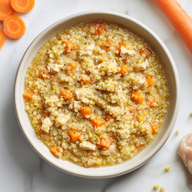 Main DishesChicken & Millet
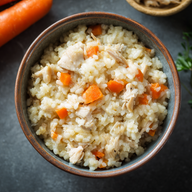 Main DishesChicken & Rice
 Snacks & TreatsChicken Jerky (Dehydrator)
 Special OccasionsDog Sushi
 MagazineDried chicken hearts from the ovenFrom “Homemade dog treats”
 MagazineBland diet for dogs – chicken and rice (1 : 2)From “Bland diet for dogs”
 MagazineChicken broth ice cubesFrom “Homemade dog ice cream”
Similar foods
- YesGrains & sidesRiceOnly cooked and without salt, stock or seasoning, as a small extra portion with the food.See the answer
- In moderationVegetablesPotatoOnly cooked and peeled; raw, green and sprouting potatoes contain solanine.See the answer
- YesVegetablesCarrotRaw or cooked, without salt, butter or seasoning, in small pieces; not carrot cake.See the answer
- In moderationGrains & sidesRuskOnly plain rusks without chocolate or raisins, and rarely, because of the sugar and calories.See the answer
- In moderationOtherEggOnly fully cooked, without salt or fat, and no more than once or twice a week.See the answer
- In moderationFishSalmonOnly cooked through, boneless and unseasoned, no more than once a week.See the answer
Sources
- Can Dogs Eat Chicken? – American Kennel Club (AKC)
- Can Dogs Eat Chicken? – PetMD (vet-reviewed)
- Hähnchen häufig mit Salmonellen und Campylobacter belastet (Presseinformation 06/2010) – Bundesinstitut für Risikobewertung (BfR)
- Verbrauchertipps: Schutz vor lebensmittelbedingten Infektionen mit Campylobacter – Bundesinstitut für Risikobewertung (BfR)
- Raw meat-based diets (Fact Sheet) – ESCCAP – European Scientific Counsel Companion Animal Parasites
- Feeding treats to your dog – WSAVA Global Nutrition Committee
- Chicken, broilers or fryers, breast, meat only, cooked, stewed (SR Legacy, FDC 171478) – USDA FoodData Central
- Chicken, broilers or fryers, skin only, cooked, stewed (SR Legacy, FDC 171056) – USDA FoodData Central
Reviewed on · DoggoMeal editorial team
This page is no substitute for veterinary advice. Dogs with pre-existing conditions – for example of the kidneys, liver or pancreas, or with diabetes – and dogs with allergies often need their own rules. If your dog has symptoms or you're unsure, ask your vet.
Recipes that fit your dog
DoggoMeal is an app for iPhone and Android: you create a profile for your dog, choose a recipe, and the app calculates grams, kcal and portions to suit your dog's weight, age, activity and allergies.
- Dog profile
- Recipes with gram amounts
- Allergy warnings
- Cooking with video
Free · no subscription · every feature included
