
House-training: how your puppy learns to stay clean
By the DoggoMeal editorial team7 min read
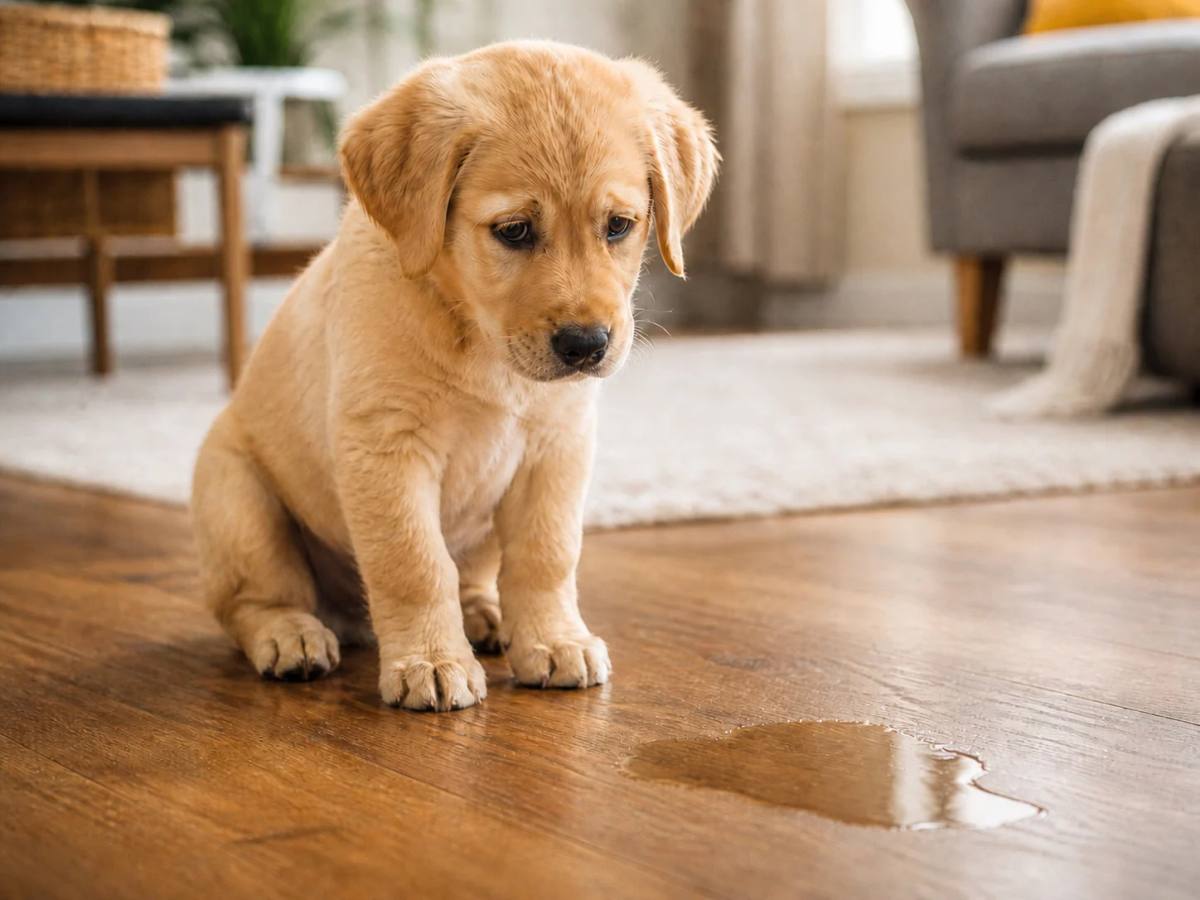
A puppy becomes house-trained when you give them enough chances to relieve themselves outside – especially straight after sleeping, eating and playing – and praise them lavishly when they do. Very young puppies under three months need a chance about every 1.5 to 2 hours. Punishing accidents doesn’t help: wipe up calmly and remove the smell with an enzyme cleaner.
New dog owners know it only too well: these little puddles everywhere 💦. The first weeks with a puppy can be a damp affair. But do not worry — no dog is born house-trained, and every dog can learn it. It takes a little patience, consistency and above all the right measures from the start. Here you will learn how your small four-legged friend understands as quickly as possible that his toilet is outside, and how to deal with accidents without losing your nerve.
A clumsy puppy sniffs excitedly at the floor and turns in circles — high time to get him to the door quickly. Anyone who spots these signs and reacts fast is spared many a puddle in the house and instead gets to praise a good dog lavishly outside.
The ABC of house-training
The key lies in attention and timing. A puppy has no control over his bladder and bowel yet — that only develops with time. Up to about twelve to fourteen weeks the little ones physically cannot hold on for long. For you that means: you have to anticipatewhen your puppy needs to relieve himself and take him outside in good time . In principle you are training yourselfto pay close attention and act fast, until your dog is ready to signal it on his own.
Here are a few tips for house-training 🐾:
- Go out often 🚶: Yes, that is the hard truth at the start — you will have to get out into the fresh air a lot. A very young puppy (< 3 months) should be given the chance about every 1.5 to 2 hours to relieve himself . At three to four months that extends to around three hours, and at five to six months many can already hold on for four hours — but that is individual. As a rule of thumb: better once too often than once too seldom. Set alarms at sensible intervals.
- After sleeping, playing and eating ⏰: There are critical moments in which something is almost guaranteed to come. Immediately after waking up — puppies sleep a lot and often, and usually they need a wee straight afterwards. So: puppy opens his eyes, you scoop him up and off you go to the designated toilet spot. After eating or drinking — a full tummy quickly presses on the bladder and bowel, so it is better to go out about ten to fifteen minutes after the food. After playing and romping — the excitement often gets the bladder going too. Do keep to these times . If you use these natural rhythms, you are already halfway to success.
- Recognising the signs 👀: Your puppy will usually give signs that he needs to go — learn to read them. Typical signs are: restlessness, suddenly sniffing about the floor in a hurry, turning in circles, whining or heading for the door. If you notice something like that: pick him up straight away and out with him. At the beginning it all often happens surprisingly fast — the little one is playing, stops abruptly, sniffs and crouches down… oops. The more often you watch him, the sooner you will spot "he is about to go". In that moment it means running.
- The toilet spot 🌿: At the start it helps to have a particular area outside where the puppy is meant to relieve himself (always one corner of the garden, for example, or for flat-dwellers always the same patch of grass outside the house). Take him there on the lead so he does not just run about. Stand there being boring and let him sniff. Many puppies need a few minutes to concentrate — patience. When something comes: huge praise! 🎉 A joyful voice, stroking, perhaps a mini treat. He should notice: weeing outside means a party. You can also introduce a cue word , saying "go wee" in a friendly tone while he is doing it — at some point he links the two, and weeing on command is handy (before a car journey, for instance).
- Praise, praise, praise: That cannot be stressed enough. Many puppies look baffled at first about why you are so delighted by a pile, but believe me, positive reinforcement works wonders. So every time something gets done outside: praise exuberantly, as if he had just won the lottery. That motivates him to do it there again.
- Night rounds: A puppy cannot last long at night either. Prepare yourself for going out at night in the first few weeks. It is best to put the puppy in a crate or a fenced area next to your bed, then you hear him when he gets restless. Many puppies announce themselves at night by whining or scratching when they need to go. Then it means: throw on a jacket half asleep and out. Until about three or four months old, many puppies need one or two toilet trips at night. After that it gets better. Tip: Reduce the water intake late in the evening (do not let him go thirsty, of course, but give nothing for an hour before bed, for example), and go out right before bedtime once more, thoroughly, so he falls asleep with an empty bladder.
- No punishment for accidents ❤️: This is really important: your puppy is not doing it on purpose. Telling him off, pushing his nose in it, raising your voice — he does not understand any of it in connection with the puddle. In the worst case he thinks you are afraid of his urine or that weeing is bad in general, and then next time he hides it behind the sofa. So, however annoying it is: stay calm. If an accident happensand you did not catch him in the act: simply wipe it up without comment (ideally with an enzymatic cleaner or vinegar water, to remove the smell) . No "bad dog" afterwards — he cannot make the link, even thirty seconds later he no longer understands the connection.
- Reacting properly when it happens: Ideally you catch your puppy in the moment of doing it — when he is just crouching down in the living room, for example. Then you can say "no" calmly but firmly, pick him up straight away (yes, he may keep dripping as you lift him, eyes shut and get on with it) and carry him quickly outside. Put him down there — maybe he will finish off a little, and then of course praise him as if it were all his own doing. That way he learns: interrupted indoors, praised outdoors. That moment is what matters. If you noticed a few seconds too late and he has already finished, then as said it is too late for a correction. In that case simply clean up quietly.
- Have patience: Every puppy is different. Some get it in a few weeks, others need months. Some are (almost) reliably house-trained at twelve weeks, others only at five or six months — that is individual . Small breeds often need a bit longer, because their bladder is so tiny. Draw the comparison with human babies: some are dry early, others later. It has nothing to do with intelligence. So be patient with your little rascal. It will happen, but above all it depends on your consistency.
- Night and alone training: If your puppy has to stay alone at night or for a few hours in the longer term, arrange his surroundings so that small accidents are no drama. Many people set up a puppy pen with a puppy toilet (newspaper or special pads in one corner). However: every use of a pad indoors can lengthen the training, because the puppy learns "indoors on a pad is fine". Sometimes there is no other way, for instance in a flat high up with no lift or when you cannot get out every two hours — then a puppy mat is the lesser evil. But try to get away from it quickly. Better to go out more often than to teach the puppy to go on pads indoors. At night you can put a crate next to the bed for him to sleep in — most dogs do not go in their own bed (an innate instinct for a clean nest). As soon as he gets restless, straight out with him. That way you get through the first nights more or less dry. Over time he will sleep through for longer and you can gradually do away with the crate if you like.
Cleaning up accidents properly
One more household tip: if something does go wrong, do not clean with ammonia-based products — to the dog they smell like urine themselves. Special enzyme cleaners or vinegar water are better, to neutralise the smell completely. Otherwise dogs tend to use the same spot again if it still smells of wee there.
Last of all: stay positive. It can be exhausting to be constantly attentive and to wipe up puddles. But remember, your puppy does not want to annoy you. He simply does not understand yet. Every carpet that suffers, every trip with the mop is temporary. With a few weeks of training you will see enormous progress. At some point the day comes when your dog scratches at the door or looks at you expectantly — and you know: now he needs to go! Then you have done it.
Routine in a puppy's day
A steady routine makes life easier for puppies — with house-training too. DoggoMeal helps you with recipes and a portion logic based on your puppy's age and target weight, plus reminders for meals — so that at least the feeding side of the day is structured.
And if there are setbacks (many puppies are almost clean and then there is another phase with accidents): do not despair, simply pay more attention to the routine again. It will come. In a few months you will laugh about it — and your dog will do his business outside as a matter of course, as it should be. Keep going, it pays off for a house-trained life together.
Written by
DoggoMeal editorial team
DoggoMeal is the editorial team behind the recipes and Doggopedia articles in the app.
Editorial team & methodology22 more articles are waiting in the app
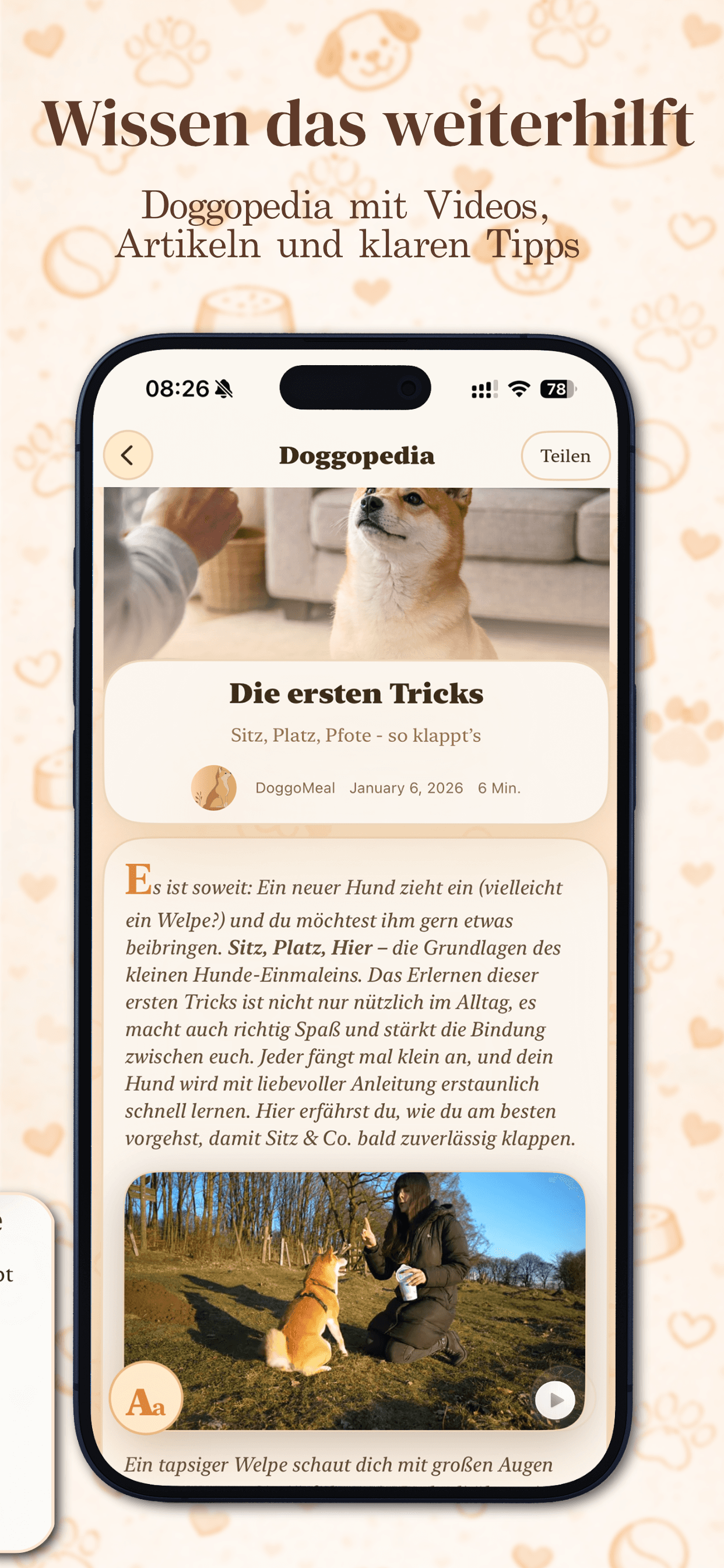
This page is a free sample. You'll find all the other Doggopedia articles and recipes with amounts tailored to your dog in the DoggoMeal app.
- Doggopedia
- Dog profile
- Recipes with gram amounts
- Community
Free · no subscription · every feature included
More free samples
- Separation anxiety: when your dog won’t stay aloneHealth · Wellbeing
- In season: everything about your female dog’s heatHealth · Wellbeing
- Body language: how to understand your dogHealth · Wellbeing
- Lead training: walking calmly on the leadTraining · Handling and training
- Shedding: when your dog leaves hair everywhereHealth · Grooming