
Separation anxiety: when your dog won’t stay alone
By the DoggoMeal editorial team8 min read
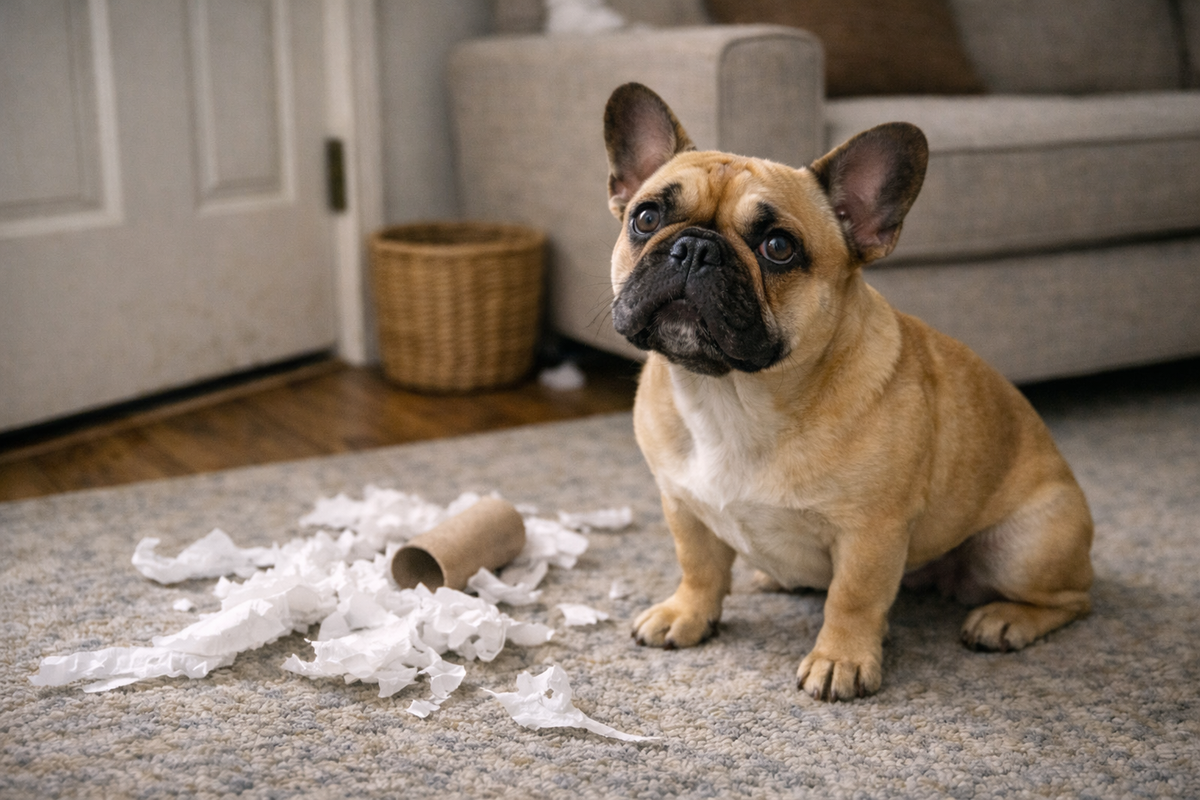
A dog with separation anxiety howls, destroys things or relieves themselves indoors only when left alone. What helps is training in small steps: first just a few seconds behind a closed door, then gradually longer absences – and come back while your dog is calm. If there is still no progress despite training, a dog trainer, behaviour therapist or vet can help.
Destroyed cushions, howling complaints from the neighbours or that sad look 💔 when you head out of the door — separation anxiety in dogs is a widespread problem and can be very hard on an owner's heart and nerves. Does your dog stick to you like glue and get stressed as soon as he is meant to stay home alone? Then read on: we look at why some dogs develop separation anxiety and what you can do to teach your four-legged friend to be alone without drama every time.
A quiet whimper behind the door, scratch marks on the frame and a dog pressing against you in panic as you say goodbye — scenes like these break any dog owner's heart. Separation anxiety is a distressing situation for both dog and human.
How do you recognise separation anxiety?
Typical signs: your dog starts to howl, bark or whineas soon as you leave — sometimes as soon as you just pick up your jacket and keys. Perhaps you hear about it from the neighbours or through a pet camera. Some dogs also become destructive: they chew furniture, door frames or shoes, scratch at doors or move things around. Out of stress they often also relieve themselves indoors (urine or faeces), even though they are actually house-trained. Badly stressed dogs pant, drool and can even injure themselves (scratching their paws raw, for instance). When you come home, a dog with real separation anxiety often seems excessively relieved or sometimes completely stressed and exhausted. Important: these symptoms occur only when the dog is alone — if someone is with him, it does not happen. Then separation stress is probably behind it, not simple naughtiness.
Causes: why is my dog afraid of being alone?
Dogs are pack animals, and it is in their nature to dislike being alone . In the wild, being alone potentially means danger. Dogs can nevertheless learn that it is normal to be without their human pack for a while. But if a dog has never learnt it or has had bad experiences, he develops separation anxiety. Common causes: no habituation — during puppyhood, for example, he was always with someone, and suddenly he is supposed to manage. Or traumatic experiences: a rescue dog who has been abandoned or passed between owners understandably clings hard. Changes such as a move or the loss of an animal housemate can also trigger separation stress, even in adult dogs who were fine before. Sometimes a certain need for control is behind it ("keeping my humans together") — trainers distinguish here between genuine fear and a loss of controlissue, where the dog thinks he has to keep watch . In both cases it shows itself similarly, but the approach is basically the same: showing the dog that being alone is no danger and not the end of the world.
Preventing it from an early age
Ideally the training starts early. A puppy should learn step by step that it is normal to be without you sometimes. At the beginning it is enough for him to learn that you are in another room and that he does not witness everything (go to the loo alone, for instance, without the puppy coming into the bathroom). Later, short absences, only a few minutes outside the door and straight back in — that is how he gets used to the fact that you always come back. The best moment for training is when the dog is tired and content (after a walk and a meal, for instance), as he will probably nod off anyway. Practising early saves a lot of grief.
But what if it is already too late and your (possibly already adult) dog panics when alone? Then it means calmly starting again from zero and practising in small steps. Here is a training plan in stages 🪜that has proven itself:
- Practise mini goodbyes 🚪: Start by leaving your dog in a room and simply closing the door for a few seconds while you stand outside. Do not make a big fuss about it — go out without a word, count to five and come back in relaxed. If that works without howling, praise him calmly (but not with exaggerated enthusiasm, or it heightens the excitement). Slowly increase the time to ten, twenty, thirty seconds. The aim: your dog should understand that you always come back, even if a door was closed.
- Leaving the house in short intervals: Next you simulate really going away. Put on shoes and jacket, take the keys — all the triggers he knows. At first perhaps just the jacket on and off again. Then really out of the door, the door clicks shut — and after ten seconds back in, quite calmly. Best kept so short that he does not even start barking. Bit by bit you extend the time outside: one minute, two, five, ten, always in varying order. Important: come back only when he is calm at that moment. If you hear him howling, wait for a moment of quiet (even if it is only a pause) before you go in, otherwise you accidentally reward the howling.
- No big farewell dramas: Hard as it is, avoid showing your dog a lot of emotion when you leave. A pitying "poor darling, I will be back soon, be good, mummy is coming right back, yes?" in a baby voice only reinforces his feeling that something bad is happening. Better: ignore your dog for ten to fifteen minutes before you go, get ready, and then leave the flat without a word. Likewise on your return: greet him only once he has calmed down a little, and then calmly. That way you signal that leaving and coming back are no big deal.
- Aids to relaxation 🛏️: It can help to create a safe retreat for the dog — many dogs feel better staying in a familiar basket or an open crate rather than having to patrol the whole flat. A worn T-shirt of yours in the basket can also be calming (the smell of their human). Quiet background music or radiohelps some, so that absolute silence (which makes them startle at every noise outside) is avoided. There is even special relaxation music for dogs.
- Give them something to do: Shortly before you leave, you can give your dog something especially good that lasts a while — a food Kong filled with something tasty that he has to work at for a time, for instance. Or a special chew (but only if you know he will not choke on it or similar). That gives him a positive occupation when you go. Many dogs are then so absorbed in chewing that their human is long gone and they have barely noticed. Careful: this does not work for everyone — some dogs will not even look at the wonderful Kong when their panic is too great. But it is worth a try.
- Tire the dog out before being left alone: A tired dog is a relaxed dog. Before you leave, go for another proper walk, play ball, let him run — whatever he likes — so that he lowers his energy level . When his physical and mental needs are met, it is easier for him to settle . Straight after a long walk the chance is higher that he will have a sleep rather than run riot in the flat.
- Develop a routine: Dogs are creatures of habit. Try to keep to a fairly fixed sequence when it comes to being left alone. For example, every morning after feeding and the walk you put the dog on his spot, give him his Kong and leave the house. Or a cue phrase such as "back soon" can be used as a signal. A clear routine takes away some of the uncertainty, because he knows what is coming.
Patience, patience, patience
The biggest challenge is probably you yourself — namely staying patient. Alone-training is rarely done in a few days. It can take weeks, even months, especially with stubborn separation anxiety. Make small steps of progress and celebrate them. Perhaps last week you could hardly get out of the door without him barking, and this week he manages five minutes calmly — excellent. Carry on in mini steps.
When is professional help needed?
If you see no progress despite all your efforts, do bring in a dog trainer or behaviour therapist . Separation anxiety is a complex subject and severe cases need individual solutions. A good trainer can see through video analysis, for instance, exactly when your dog shows signs of stress, and tailor the training accordingly. In extreme cases (a dog having panic attacks, injuring himself and so on) it can also be worth talking to the vet about supporting medication with an anxiety-relieving effect — but that should be considered a last option and always used in combination with training.
Emergency management
Until your dog can manage reliably, try to avoid real alone-phases as far as possible, to prevent setbacks. If you have to go to work and he cannot do it yet, organise help: family, friends, neighbours, a dog sitter or dog day care. No dog should have to spend hours in panic — and quite apart from that, damage to the flat can get expensive. As a rule of thumb: at most six hours is how long an adult dog should be alone at all, even without anxiety . With a dog who has separation anxiety, ideally not at all until the training takes hold.
You are not alone with this
Separation anxiety occupies many owners. In DoggoMeal you can exchange ideas with others in the community, ask questions and see how others organise their day with similarly sensitive dogs — recipes, knowledge and exchange in one app.
Finally: however bad it seems at the moment, every dog can learn to stay alone calmly. Some need far more practice and encouragement, but it is doable. Stay consistent and sensitive. Your dog does not want to annoy you, he really is afraid or stressed. Show him step by step that he does not need to be afraid — that you always come back. Have confidence in you both. Over time you will get from the five-second door closing to thirty minutes, to an hour, to three hours. And at some point you will notice: hey, I come home and my dog is sleeping peacefully instead of howling — goal reached. Keep going, it is worth it for you both.

Written by
DoggoMeal editorial team
DoggoMeal is the editorial team behind the recipes and Doggopedia articles in the app.
Editorial team & methodology22 more articles are waiting in the app
This page is a free sample. You'll find all the other Doggopedia articles and recipes with amounts tailored to your dog in the DoggoMeal app.
- Doggopedia
- Dog profile
- Recipes with gram amounts
- Community
Free · no subscription · every feature included
More free samples
- House-training: how your puppy learns to stay cleanTraining · Handling and training
- In season: everything about your female dog’s heatHealth · Wellbeing
- Body language: how to understand your dogHealth · Wellbeing
- Lead training: walking calmly on the leadTraining · Handling and training
- Shedding: when your dog leaves hair everywhereHealth · Grooming