
In season: everything about your female dog’s heat
By the DoggoMeal editorial team6 min read
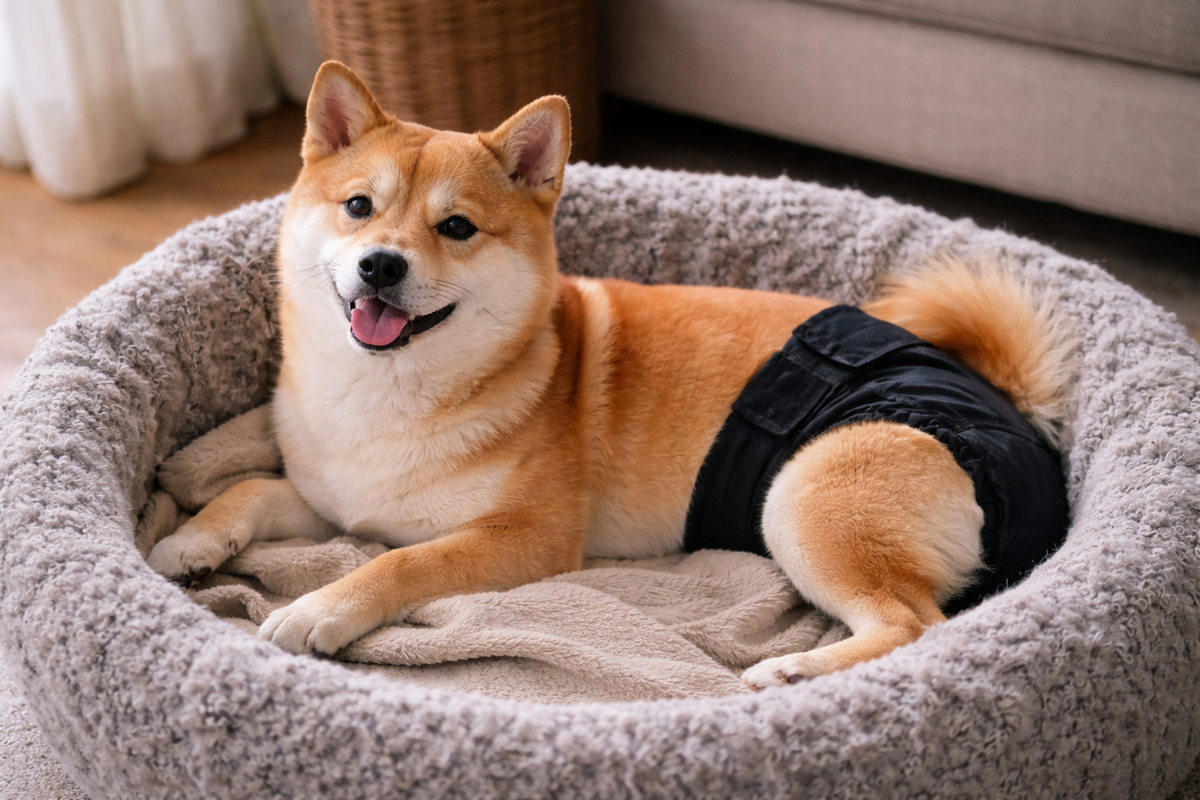
A female dog’s first season usually comes at 6 to 12 months, in large breeds sometimes not until 12 to 18 months; after that, she usually comes into season every six to eight months. A season lasts about two to three weeks on average. When the bleeding eases, the fertile standing heat begins – from then on, only walk her on the lead and never leave her outside unsupervised.
The first spot of blood on the floor 🩸 — your little girl has grown up. When a female comes into season, many owners face new questions: How long does this last? What do I need to watch out for? Why is she suddenly behaving differently? Do not worry, this is part of a female dog's natural life cycle. With a little knowledge and preparation you can handle this special phase confidently and help your dog through the season well.
A female licks herself constantly and leaves small drops of blood on the floor — the season is a special time in which both dog and owner face new challenges.
What does in season mean?
The season (colloquially also heat) is the fertile phase in a female's cycle. During this time she is ready to mate. Depending on breed and development, the first season usually occurs at the age of six to twelve months (very small breeds earlier, large breeds sometimes only at twelve to eighteen months). After that most females come into season every six to eight months as a rule . There are individual variations — some females come into season only once a year, others fairly punctually twice a year.
Duration and course
A season lasts on average about two to three weeks. It runs in several phases with different features:
- Pro-oestrus: The first seven to ten days. The vulva swells and a bloody discharge begins. Males already take an interest in her scent, but she herself is not yet ready to mate and usually rebuffs suitors clearly.
- Oestrus: The actual standing heat, roughly days ten to fifteen of the season. The discharge becomes more watery or pale pink and lessens. The female is now fertile and ready to mate — many females now stand for the male, meaning they move the tail to the side and would allow mating. In this short phase (about five to nine days) fertilisation can take place .
- Met-oestrus / dioestrus: The female is no longer receptive, the vulva goes down again, the discharge stops. The body now adjusts either to puppies growing (if fertilisation took place) or — far more often — to no offspring coming. In this phase, though, the symptoms of a false pregnancy can appear (see above), because hormonally it is initially assumed that there could be puppies.
- An-oestrus: The long pause between seasons, usually several months, in which the reproductive system rests and nothing in particular happens. The next season then announces itself at some point with the vulva swelling again.
So on average females are in season twice a year. If your dog comes into season noticeably more often or far more rarely, that can point to a health problem — talk to your vet if you notice irregularities.
Signs that your dog is coming into season
The most obvious are of course the drops of blood 🩸your dog loses. Some females keep themselves very clean, others drip more — you may find small spots on the floor or the dog bed. Many owners put special season pants with a pad on their dog indoors to prevent stains. Another sign is the swollen vulva (the genital area); shortly before the heat begins you can see that it is distinctly puffed up. The behaviouroften changes too: some females become clingier and more cuddly in the days before the season, others more snappy or restless. Females in season often also urinate more outside, to spread their scent — they are laying scent marks, so to speak, telling males that a lady is looking for company.
During the season — behaviour and tips
In the first phase (pro-oestrus) your dog will probably be surrounded by many males, but she herself has no interest yet. She may even react quite crossly when a pushy suitor sniffs — that is normal. At the latest when the bleeding eases (after about nine or ten days) you should pay extremely close attention, because now the willingness to mate begins . Never leave your dog unsupervised outside in this phase, not even in the garden — males scent a female in season from a great distance, and even high fences or closed doors sometimes do not stop a motivated candidate. It is best to walk only on the lead now and avoid dog parks or encounters with off-lead males. Even the most obedient female can suddenly be deaf to commands in standing heat and may even run off to find a male. So: better safe than sorry.
Worth knowing: many females become a little moody during the season or behave differently than usual. They can be clingier, but some also get more irritable towards other dogs (females in particular can snap at each other during this time). That is hormonal. Provide a stress-free environment, do not press your dog with new training or the like. Cuddle and play at her pace. Some females suffer physically a little — slight swelling can be uncomfortable, comparable to menstrual cramps in people. As a rule, though, they cope well.
Hygiene
Your dog will clean herself a lot. You can support her by washing her blanket or bed more often during this time. The season pants mentioned can be useful indoors, but always take them off outside in case she needs to go. Many females instinctively feel the urge to relieve themselves a lot during the season (frequent small wees) in order to set scent marks — so always carry a few extra poo bags and perhaps plan slightly longer walks with more sniffing time, because she wants to read and leave messages everywhere.
Preventing an unwanted mating
If you are not planning offspring, it is your responsibility to control encounters with males during this time. There are sprays that are meant to mask the smell, but do not rely on them — a determined male notices what is going on regardless. Nor should you count on one moment of inattention passing harmlessly. Dogs are lightning fast at the act of love, and once tied it is too late. So really: lead on, eyes open, and if need be make a wide detour or turn around when an off-lead male comes towards you. Other dog owners generally understand — signal early that your dog is in season, and most will put their males on the lead too.
After the season
Once the heat is over, normality returns. Note, though, that about two months after the season a false pregnancy canoccur, as described above. Signs of it should pass after a further two to three weeks. If you do not want offspring and the whole season circus seems too demanding or stressful, you could consider spaying . That prevents future seasons, false pregnancies and of course unwanted pregnancies. It is however an irreversible procedure and should be discussed thoroughly with your vet (timing, risks, effects). Many vets recommend waiting at least until after the first season before spaying, so the dog is physically mature.
Let the profile grow with her
Needs change — hormonally too. In DoggoMeal you can adjust your dog's weight, activity and particulars at any time, and the recipes follow along.
All in all: a season is no reason to panic. Millions of females and owners manage it. With a little preparation — season pants, the lead, walks planned ahead — you will get through these weeks well. Your dog will be entirely her old self afterwards (until the next six months are up). Take time for her, be patient with mood swings, and perhaps allow her an extra treat or two to lift her spirits. The spook will soon be over.
Written by
DoggoMeal editorial team
DoggoMeal is the editorial team behind the recipes and Doggopedia articles in the app.
Editorial team & methodology22 more articles are waiting in the app
This page is a free sample. You'll find all the other Doggopedia articles and recipes with amounts tailored to your dog in the DoggoMeal app.
- Doggopedia
- Dog profile
- Recipes with gram amounts
- Community
Free · no subscription · every feature included
More free samples
- House-training: how your puppy learns to stay cleanTraining · Handling and training
- Separation anxiety: when your dog won’t stay aloneHealth · Wellbeing
- Body language: how to understand your dogHealth · Wellbeing
- Lead training: walking calmly on the leadTraining · Handling and training
- Shedding: when your dog leaves hair everywhereHealth · Grooming