Dog weight loss: diet plan, calories and food amounts
A diet plan for dogs: calories by target weight, 1–2% weight loss a week, staying full with veg and cottage cheese, a treat budget and a food amount table.
By the DoggoMeal editorial teamPublished Updated 9 min read
In short
To lose weight, your dog starts on their resting energy requirement at the target weight (70 × target weight^0.75): a 12 kg dog with a target of 10 kg ends up at around 395 kcal instead of 720 kcal a day. About 1–2% weight loss per week is healthy, and treats count too. If, on the other hand, your dog is losing weight unintentionally, that's a matter for the vet.

Nami puts on weight quickly when treats aren't kept in check. She loves treats (she's extremely greedy), but we keep strict control. The daily ration is the daily ration.
To lose weight, your dog's starting point is just their resting energy requirement at the target weight: 70 × target weight^0.75 kcal per day. For a 12 kg dog with a target weight of 10 kg, that's around 395 kcal instead of the 720 kcal they would need to maintain their current weight. About 1 to 2% weight loss per week is healthy – and treats always count.
An example: a female Labrador weighs 34 kg, and her target weight is 28 kg. As her diet starting point, she gets around 850 kcal a day. At 1 to 2% per week, she loses 340 to 680 g a week at first – so reaching the target takes roughly two to four months. This is exactly the route we'll walk through here.
First, take an honest look: is your dog really overweight?
The scales alone don't tell you much. A muscular dog weighs more than a couch potato of the same size. What counts is the Body Condition Score (BCS) on the WSAVA's 9-point scale. 4 or 5 is ideal.
How to check for yourself:
- Ribs: You should be able to feel them without pressing – like your knuckles on the back of your hand. If you have to press, there's too much fat over them.
- Waist: Seen from above, a clear indentation behind the ribs. A barrel shape means overweight.
- Belly line: From the side, the belly tucks up slightly. If it runs straight or sags, that's a warning sign.
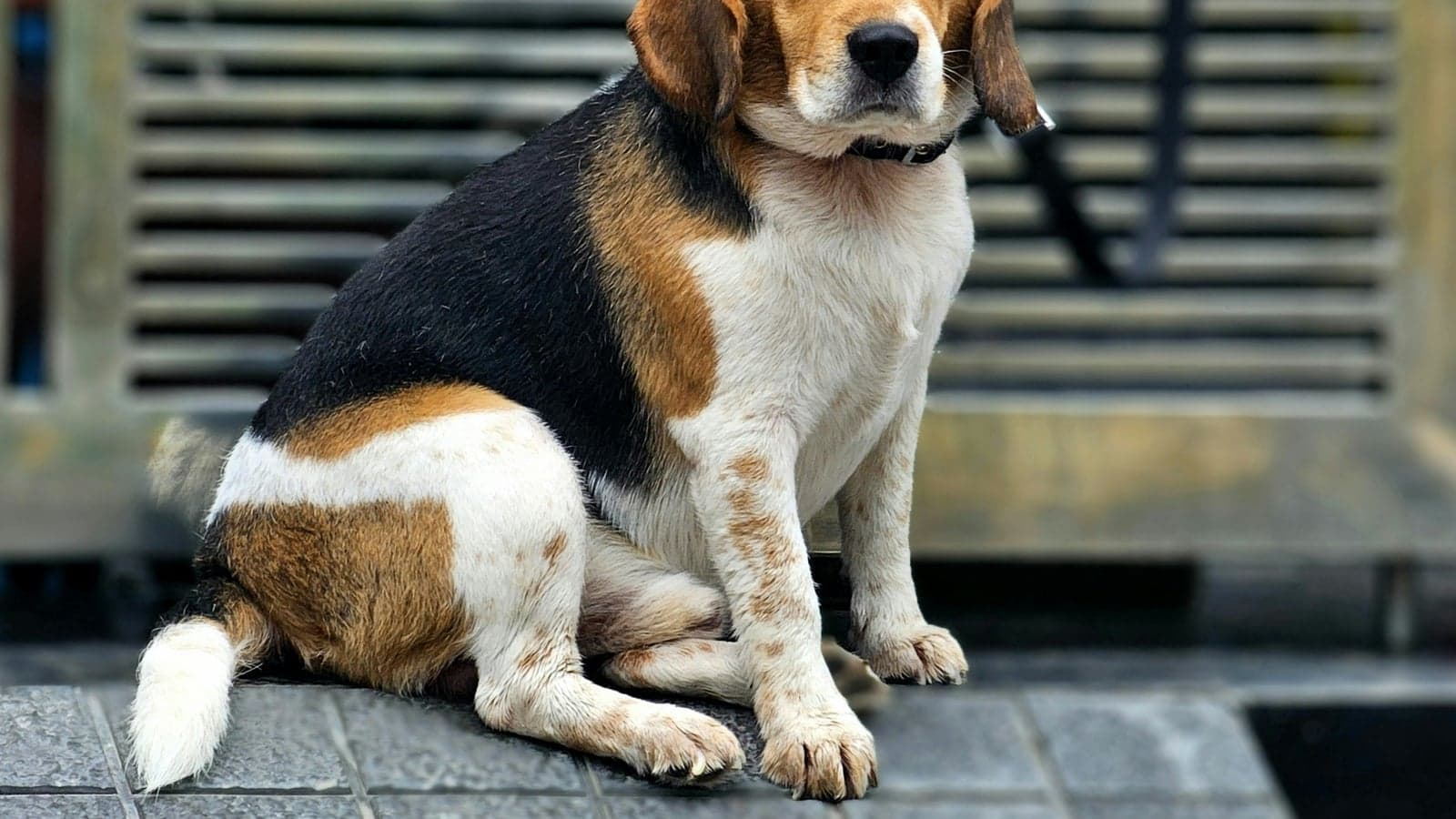
In many breeds – Labrador, Beagle, Pug, Dachshund – excess weight is often played down as “sturdy”. Yet overweight dogs live shorter lives on average: in an analysis of more than 50,000 neutered dogs from twelve breeds, median life expectancy was lower in every breed when the dogs were overweight – in Yorkshire Terriers by around two and a half years.
Diet plan: how much your dog can eat while losing weight
The starting point for the diet is the resting energy requirement at the target weight, i.e. 1.0 × RER (70 × target weight^0.75). The energy density of the food then turns the calories into grams. The table shows examples – dry food with 360 kcal and wet food with 100 kcal per 100 g:
Diet foods often contain less than 360 kcal per 100 g – in that case your dog can eat correspondingly more grams. Always calculate with the figure on your packaging. The calculator's diet mode gives you the exact value for your target weight: work out your dog's calorie needs. With the kcal figure, you can then work out the food amount for your dog.
Three things matter here:
- This is considerably less than before. If you simply cut your normal food drastically, your dog also gets fewer vitamins and minerals and less protein. The more you cut back, the more sense it makes to use a complete diet food that provides everything necessary despite the lower calories. Discuss this with your vet – from a BCS of 7 out of 9, the diet should be supervised by a vet anyway.
- Weigh instead of guessing. Weigh every one to two weeks, on the same day of the week, at the same time, before a meal. The goal is 1 to 2% per week.
- Adjust. If your dog loses less than 1% per week over two to three weeks, reduce the amount by 5 to 10%. If they lose more than 2% per week, give a little more.
The lower end is more realistic: in an international study of 926 overweight dogs, the dogs lost an average of 11.4% of their weight in three months – just under 1% per week. Plateaus of one to two weeks are normal.
More protein, less fat
When losing weight, your dog should lose fat, not muscle. That's why the protein content stays high while the fat content comes down. If you cook yourself: lean poultry or lean beef instead of fatty cuts, and only as much oil as necessary. More on how much protein a dog needs in our guide to how much protein a dog needs.
Vegetables and cottage cheese: filling and low in calories
Vegetables add volume and fibre with little energy. Good choices are courgette, cucumber, carrot, green beans (cooked) and broccoli in small amounts. This way, part of the ration can be replaced with vegetables – the bowl looks fuller and your dog chews for longer. Important: the basic ration still has to provide all the nutrients.
Low-fat cottage cheese is high in protein and works as a small topping or training titbit – as long as your dog tolerates dairy. But it does have calories and belongs in the daily budget. Amounts and lactose are covered in our guide to quark and cottage cheese for dogs.
Diet recipes: what matters
A diet recipe for dogs saves calories, not nutrients. You can do this with home-cooked food, but only with a properly calculated recipe. Here's what matters:
- A lean protein source as the base: Turkey breast or skinless chicken breast instead of fatty cuts. For comparison, from the WSAVA treat guide: 28 g of lean turkey breast has around 50 kcal, 28 g of Cheddar around 120 kcal.
- Fibre and vegetables to keep your dog full: In a study of overweight dogs, those on a high-protein, high-fibre food lost more weight, and lost it faster, than on a food with the same energy density but less fibre. Courgette, carrot, pumpkin or green beans bring volume to the bowl.
- Oil and calcium as the recipe specifies: In an analysis of 200 published recipes for home-cooked dog food, 95% lacked at least one essential nutrient in sufficient amounts. Fewer calories don't make that any easier.
- Calculate amounts instead of estimating: The grams per ingredient depend on the target weight.
Suitable bases from our collection include Turkey & potato with turkey breast, potatoes and carrots, or Turkey & rice with turkey breast fillet, rice and pumpkin. We've deliberately left out gram amounts there: the DoggoMeal app converts every recipe, with grams per ingredient, to your dog's diet calories. If your dog is significantly overweight or has existing conditions, discuss the plan with your vet practice first.
Exercise: build it up slowly
You don't have to turn into a marathon runner. Slightly longer walks, search games in the garden, fetch on a slope or swimming (easy on the joints) all help – always to suit your dog's age, joints and health. With short-nosed breeds such as Pugs or French Bulldogs, never in the heat and never for too long at a stretch.
Treats are the hidden calorie traps
Three chews, a chew strip, two training titbits – before you know it, that's 200 kcal. For a normally active 10 kg dog with a daily requirement of around 630 kcal, that's almost a third.
The rule: treats count. All snacks together stay below 10% of daily calories – during the diet, based on the diet calories. At 395 kcal, that's around 40 kcal. Cucumber cubes, pieces of carrot or part of the daily ration from a treat pouch are good alternatives. You'll find ideas for light snacks in homemade dog treats.
When nothing happens
If nothing at all has changed after four weeks, check three things: is someone in the household secretly feeding extra? Are the grams really right (kitchen scales rather than a measuring cup)? And is there a medical reason, such as an underactive thyroid? A blood test at the vet will clear that up.
Dog losing weight unintentionally
The opposite case is more serious. If your dog is losing weight even though you haven't changed anything about their food or exercise, that's a warning sign – especially if diarrhoea, increased drinking, vomiting or lethargy come with it. Have them examined by a vet before you increase the food amount. Warning signs, possible causes and how to feed them back up after the check-up are covered in our guide Dog losing weight: causes and when to see a vet. If your dog has stopped eating altogether, Dog not eating helps you make a first assessment.
Sticking to the plan with the DoggoMeal app
The DoggoMeal app works out the daily requirement from weight, target weight and activity, plans the reduction and logs weight and treats. That way, after two weeks you'll see in black and white whether it's working – or where it's getting stuck. Get the app.
Matching calculators, free in your browser
Frequently asked questions
How fast should my dog lose weight?
About 1 to 2 per cent of body weight per week is considered healthy. For a 30 kg dog, that's 300 to 600 grams per week. In an international study of 926 overweight dogs, average weight loss after three months was 11.4% – just under 1% per week.
How many calories does my dog need when losing weight?
As a starting point, the resting energy requirement at the target weight: 70 × target weight^0.75 kcal per day. For a target weight of 10 kg, that's around 395 kcal; for 25 kg, around 785 kcal. After that, you adjust the amount every two to three weeks depending on how the weight develops.
My dog is constantly begging – what can I do?
A diet food high in protein and fibre is more filling. Split the daily ration into three to four small meals, use a snuffle mat or slow feeder bowl, and give pieces of vegetable instead of chews. Sometimes it's boredom, not hunger.
Is cottage cheese good for weight loss?
Low-fat cottage cheese is high in protein and works as a small topping or training titbit if your dog tolerates dairy. But it counts towards the calories and is no substitute for a balanced diet food.
My dog is losing weight even though they eat normally – what should I do?
Unintentional weight loss is a warning sign. Possible causes range from dental problems, gut diseases and parasites to metabolic diseases such as diabetes. Have your dog examined by a vet before you increase the food amount.
Are light dry foods a good idea?
Only up to a point. Many contain less fat, but also less protein. Look for a high protein content, otherwise your dog loses muscle instead of fat. For dogs that are very overweight, a complete weight-loss diet from your vet is usually the better choice.
Sources
This article is based on the following expert sources. You can read how we work under Editorial team & methodology.
- Body Condition Score – Dog – WSAVA Global Nutrition Committee
- Calorie Calculator (Gewichtsreduktion 1–2 % pro Woche, Leckerli max. 10 %) – Pet Nutrition Alliance
- Association between life span and body condition in neutered client-owned dogs – Salt et al., Journal of Veterinary Internal Medicine (2019), PubMed Central
- Success of a weight loss plan for overweight dogs: The results of an international weight loss study – Flanagan et al., PLOS ONE (2017)
- A high protein high fibre diet improves weight loss in obese dogs – German et al., The Veterinary Journal (2010)
- Evaluation of recipes of home-prepared maintenance diets for dogs – Stockman et al., Journal of the American Veterinary Medical Association (2013)
- Feeding treats to your dog (Energiegehalt von magerem Fleisch und Käse) – WSAVA Global Nutrition Committee
Less maths, more cooking.
The article tells you what matters. The DoggoMeal app turns it into a recipe with gram amounts to suit your dog's weight, age, activity and allergies.
- Dog profile
- Recipes with gram amounts
- Allergy warnings
- Doggopedia
Free · no subscription · every feature included


DoggoMeal editorial team
DoggoMeal is a dog nutrition app, founded and run by Kim Marques. Nami, our Shiba, is part of everyday life – her experiences with food changes, bland diets and the like appear in many articles as personal examples.
Our content follows the recommendations of the NRC, WSAVA and FEDIAF. You'll find the sources for this article above under “Sources”. The articles are no substitute for veterinary advice – if your dog has symptoms, please talk to your vet.