
Shedding: when your dog leaves hair everywhere
By the DoggoMeal editorial team6 min read
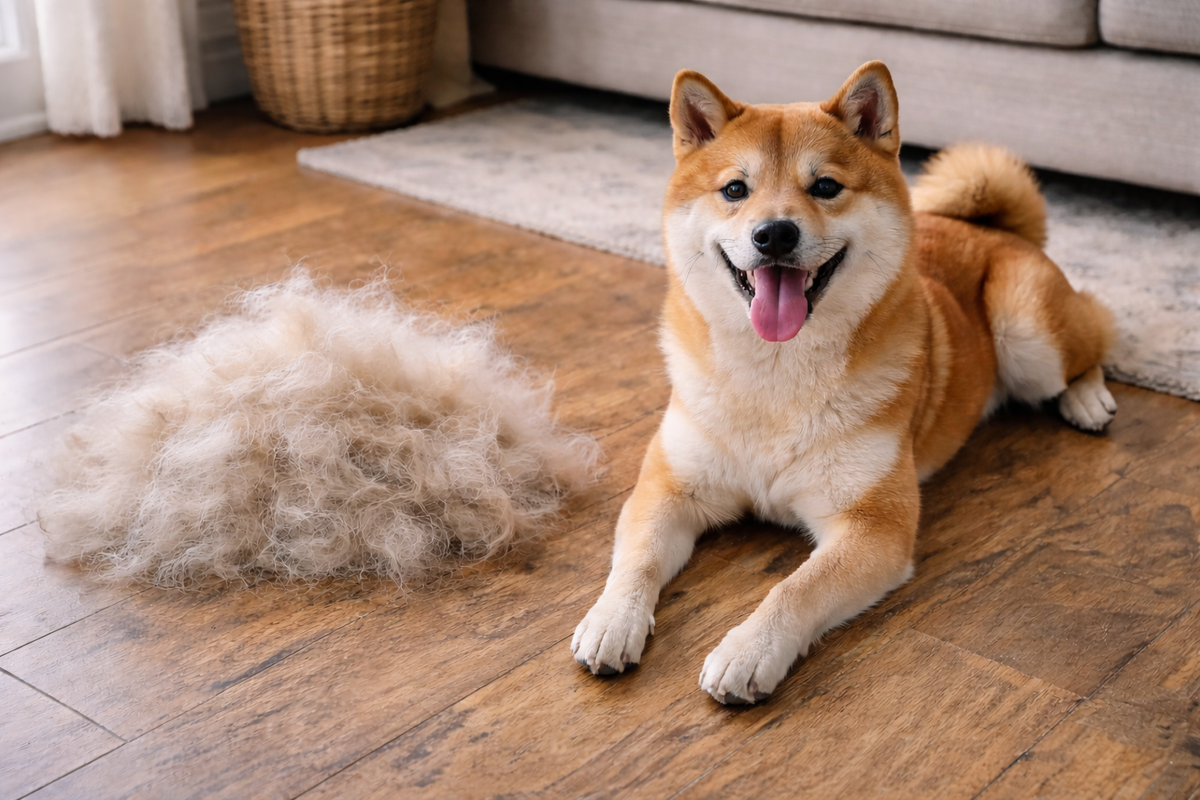
Many dogs moult in spring and autumn; breeds without an undercoat tend to shed more evenly all year round. Daily brushing with a suitable comb helps most, along with good-quality food. Bald patches, red skin, a lot of dandruff or scratching until it bleeds are not part of a normal moult – in that case, see your vet.
Twice a year the time comes: your dog sheds fur in tufts and fine hairs suddenly cover floors, sofa and clothes. The moult 🍂 is here — a demanding phase for your companion. Luckily you can help them get through this time better with a few simple measures. Here you will learn why dogs shed and what you can do so your home does not disappear under fur.
Why is there a moult?
Dogs adapt their coat to the seasons. As a rule the moult happens twice a year: in spring the dog throws off the dense winter coat so a lighter summer coat can grow, and in autumn the coat switches back to winter mode — thick undercoat comes in, ready for the cold. This natural programme is still in many of our dogs, even those living indoors. Not all breeds are the same, though: dogs without undercoat (poodles, Maltese or some terriers, for instance) often have no pronounced moult and shed moderately all year instead. With them the hairs fall out and regrow more continuously, without a seasonal explosion. In most other breeds you clearly see the signs in spring and autumn: the coat looks duller, loose hairs can be pulled out in tufts, and the dog sheds heavily. Interestingly, light and temperature 🌦️ influence the moult too: indoor dogs with a lot of heated air and artificial light can fall out of rhythm and lose hair almost permanently. Climate change with milder winters also lengthens the shedding periods. Even so, spring and autumn remain the main times for the big coat update.
Demanding for the dog
The moult is hard work for a dog's body. Within a few weeks the organism has to shed and rebuild thousands of hairs. That costs a lot of energy and nutrients. So some dogs seem a little more tired than usual in this phase, sleep more and tire faster — that is normal. Some dogs also suffer from itching, because the many loose hairs pinch and tickle on the skin. You may then see your dog scratching more often or nibbling at their coat. Support them especially during this time so they feel more comfortable.
How you can help — tips for the moult
- Brush daily 🪮: The most important thing during the moult is regular brushing, ideally really every day, or at least every other day. Thorough combing removes the dead hairs before they fly everywhere, and your dog is rid of the itch. Brushing also stimulates circulation in the skin and so prevents dry skin and dandruff. Use the right tool: for dogs with undercoat there are special undercoat brushes or fine-toothed deshedding combs that pull the dense woolly hair out. For long-haired breeds, dematting combs and brushes with rotating pins help get loose hair out of the long topcoat. Short-haired dogs are well served by rubber curry combs or grooming gloves — which massage pleasantly at the same time. What matters is really reaching down to the skin, especially with a dense coat. Work section by section when brushing (neck first, then back, then each side) so nothing is missed. Many dogs greatly enjoy this extra attention during the moult. If your dog has sore or irritated skin, however, go gently and stop if it hurts them.
- The right diet 🥩: During the moult your dog needs a good supply of protein, fatty acids, vitamins and minerals — only then can they build a strong new coat. Pay particular attention to quality food now. After talking to your vet you might support with supplements: many swear by salmon oil or linseed oil (supplying omega-3 and omega-6 fats for the coat), brewer's yeast or biotin supplements, and zinc. These can support hair growth. A little cooked egg now and then (containing biotin) or malt paste (known from cats for preventing hairballs, but it helps dogs move hair through too) can be useful as well. Much more important though: if your dog seems very listless during the moult or gets bald patches, please have a blood test done — sometimes a nutrient deficiency or thyroid problem is behind it and needs treating.
- To bathe or not to bathe? 🛁 Many people think dogs must not be bathed during the moult. That is not quite right — proper bathing can even help remove loose hairs faster. Important: use a mild dog shampoo and comb the dog through roughly before the bath. Bathing loosens sebum and dirt that often still hold the dead hairs in place. After the bath (and rinsing out all shampoo residue thoroughly) please dry your dog and brush again — you will be amazed how much fur comes out. Frequent bathing (every one to two weeks) is still not necessary. A bath at the start or towards the end of the moult can be supportive though. Otherwise brushing is entirely enough.
- Do not simply shave the coat off ✂️: If your dog sheds badly in summer you might think: off with the fur. But careful: many breeds with undercoat must not be clipped completely. Their topcoat and undercoat also act as protection against heat in summer. If you clip a husky or golden retriever down to a few millimetres, the coat often does not grow back properly and the dog can suffer heatstroke, because the temperature balance is disturbed. Better to cut out matted areas specifically and keep the coat airy by brushing. One exception: with some very old or ill dogs a summer cut can improve wellbeing — but that should be discussed with a groomer and a vet.
- Housework during the moult 🧹: Very practical for you as an owner: arm yourself with good tools against the flood of hair. Lint rollers, rubber gloves (great for rubbing hair out of the carpet), a powerful vacuum cleaner — all of that makes life easier. Perhaps your dog is not allowed on every sofa or in the bed during this phase, to limit the hair zones. Some owners also set up a special brushing spot outside in the garden or on the balcony, so the combed-out hair is carried off by the wind. And a small consolation: it is only for a few weeks, then the shedding settles down again.
When to see the vet?
Hair loss during the moult is normal. But watch for these warning signs: bald patches, redness on the skin, a lot of dandruff, or your dog scratching until they bleed. Then there could also be a skin problem or parasite infestation. When in doubt, have the vet take a look, especially if the hair loss is uneven (only on the flanks, for instance — which could point to hormonal problems).
Care and feeding belong together
During the moult especially, many owners look more closely at what ends up in the bowl. With DoggoMeal you can organise your feeding routine through recipes, gram-exact amounts and reminders — all in the same app where you keep an eye on your dog's grooming phase.
In short
The moult demands quite a lot of your dog, but with your support they feel much better. Daily brushing, good food and a little extra care help them shed the old coat and shine in the new one. And always remember: every tuft of loose hair you comb out does not land on your carpet — a win for you too.

Written by
DoggoMeal editorial team
DoggoMeal is the editorial team behind the recipes and Doggopedia articles in the app.
Editorial team & methodology22 more articles are waiting in the app
This page is a free sample. You'll find all the other Doggopedia articles and recipes with amounts tailored to your dog in the DoggoMeal app.
- Doggopedia
- Dog profile
- Recipes with gram amounts
- Community
Free · no subscription · every feature included

More free samples
- House-training: how your puppy learns to stay cleanTraining · Handling and training
- Separation anxiety: when your dog won’t stay aloneHealth · Wellbeing
- In season: everything about your female dog’s heatHealth · Wellbeing
- Body language: how to understand your dogHealth · Wellbeing
- Lead training: walking calmly on the leadTraining · Handling and training