How much should a dog drink? Calculate water intake
A 10 kg dog needs about 630 ml of water a day; on dry food, it drinks around 610 ml of that from the bowl. Choose the weight and type of food: the calculator shows the water requirement per day, how much of it comes with the food and from what amount you should see your vet.
Updated on
In short
A dog needs at least roughly as many millilitres of water a day as it burns kcal. A 10 kg neutered dog with normal activity therefore comes to about 630 ml, around 63 ml per kg. Part of it comes with the food: only about 20 ml with dry food, about 470 ml with wet food. If a dog regularly drinks more than 100 ml per kg a day – over 1,000 ml at 10 kg – that's a matter for your vet.
How much water does your dog need?
Choose the weight and type of food. The result updates instantly.
Water needs per day
≈ 630 ml
Total water, including the food
of which about 20 ml comes from the food and 610 ml from the bowl
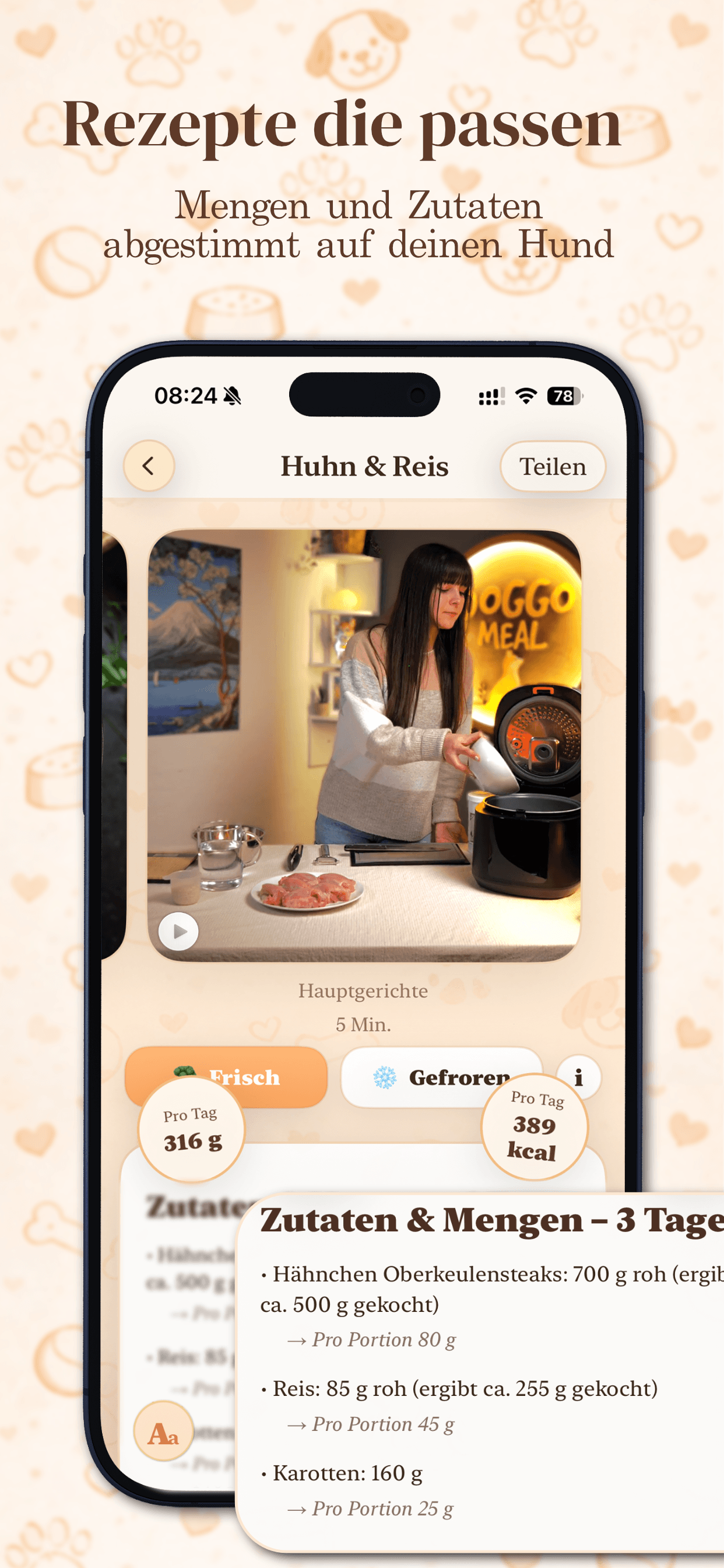
 Cook fresh instead of only dry foodThe DoggoMeal app works out recipes in grams for your dog
- From the bowl, roughly
- ≈ 610 ml
- From the food
- ≈ 20 ml
- Food a day
- 175 g dry food
- Unusually much from
- over 1,000 ml a day
How the calculator works
Resting energy requirement 70 × 10 kg^0.75 ≈ 394 kcal × factor 1.6 = 630 kcal a day, about 1 ml of water per kcal ≈ 630 ml.
175 g dry food × 10% water ≈ 20 ml.
630 ml − 20 ml ≈ 610 ml from the bowl.
When to see the vet?
If your dog regularly drinks more than about 100 ml per kg a day – at this weight over 1,000 ml – that counts as unusually much (polydipsia). Have it checked by your vet.
If your dog suddenly drinks a lot more or a lot less than usual, call your vet as well.
The calculator gives guide values and does not diagnose anything.
- Water always available: Fresh, clean water belongs in the bowl around the clock. Never ration it.
- Higher needs: Heat, lots of exercise and nursing puppies increase how much a dog drinks. The figure above is for a quiet day.
- Home-cooked: Home-cooked food contains a lot of water, so the bowl empties more slowly. The amount comes from the fresh food calculator.
Water intake by weight and food
Total = water requirement per day (about 1 ml per kcal, adult, neutered, normal activity). The other columns show roughly how much of it comes from the bowl: with dry food (10% water), wet food (75%) or freshly cooked food (70%). Rounded to 10 ml.
| Weight | Total (ml) | Dry (ml) | Wet (ml) | Fresh (ml) |
|---|---|---|---|---|
| 2.5 kg | 230 | 220 | 60 | 110 |
| 5 kg | 380 | 370 | 100 | 180 |
| 7.5 kg | 510 | 500 | 130 | 240 |
| 10 kg | 630 | 610 | 160 | 290 |
| 15 kg | 860 | 840 | 220 | 400 |
| 20 kg | 1,060 | 1,030 | 260 | 490 |
| 25 kg | 1,250 | 1,220 | 310 | 580 |
| 30 kg | 1,440 | 1,400 | 360 | 670 |
| 40 kg | 1,780 | 1,730 | 440 | 820 |
| 50 kg | 2,110 | 2,050 | 530 | 980 |
How much water does a dog need per day?
As a rule of thumb, a dog needs at least roughly as many millilitres of water a day as it burns kcal. The NRC (2006) gives 1 ml per kcal as a conservative minimum; in measurements, dogs often drank a little more. Because small dogs burn more energy per kg, they also need more water per kg than large ones. The Merck Veterinary Manual gives about 44 to 66 ml per kg for mammals at a comfortable temperature.
For adult, neutered dogs with normal activity, that means: a 5 kg dog needs about 380 ml (76 ml per kg), a 10 kg dog about 630 ml (63 ml per kg) and a 30 kg dog about 1,440 ml (48 ml per kg). The table above shows more weights.
Water from food: dry, wet, freshly cooked
Part of the water doesn't come from the bowl at all, but with the food. How much depends on the moisture content:
- Dry food: about 10% water. At 10 kg, that's only around 20 ml, so the dog drinks almost everything from the bowl.
- Wet food: about 75% water. At 10 kg, around 470 ml comes with the food, and only about 160 ml from the bowl.
- Freshly cooked: about 70% water, depending on the recipe. At 10 kg, around 340 ml from the food and about 290 ml from the bowl.
So if your dog eats wet food or freshly cooked food, a half-full bowl in the evening is no reason to worry. If the food changes, the amount your dog drinks changes too.
When a dog needs more water
The figure in the calculator is for a quiet day. Dogs drink more in hot weather, after lots of exercise and when a female is nursing puppies.
Water must always be freely available: fresh, clean and around the clock. Rationing the amount isn't a good idea, not even for a dog that drinks a lot.
When is a dog drinking too much?
In the specialist literature, unusually heavy drinking (polydipsia) in dogs means more than 90 to 100 ml per kg of body weight a day; the calculator uses 100 ml as its warning threshold. At 10 kg, that's over 1,000 ml, at 30 kg over 3,000 ml. If your dog usually drinks little, a smaller but clear increase can also stand out.
Behind this there may be illnesses that only your vet can clarify. So have it examined rather than waiting, and ideally bring a note of the amounts your dog has been drinking.
And if a dog drinks too little?
On wet food or freshly cooked food, dogs drink much less from the bowl – that's normal. But if your dog suddenly drinks much less than usual, eats poorly or seems listless, call your vet.
How to measure water intake
In the morning, pour a measured amount into the bowl, for example with a measuring jug, and note down every refill. After 24 hours, measure what's left and work out how much has gone. Do this on two or three days and take the average. Water from puddles, ponds or the garden isn't counted.
Limits of the calculator
The figures are guide values for healthy, adult dogs:
- The moisture content of food varies by product and recipe.
- A little water is produced in the body during digestion; the calculator doesn't subtract it. Many dogs still drink a little more than this minimum.
- Different values apply to puppies, pregnant or nursing females and sick dogs.
- For very small dogs under 2 kg, the rule of thumb is too inaccurate, so the calculator starts at 2 kg.
- For very small dogs under about 5 kg, normal needs are already close to the warning threshold. What matters most is whether your dog drinks clearly more than usual.
The calculator doesn't diagnose anything. If you notice something about your dog's drinking, ask your vet.
How we calculate
The calculator works via energy: a dog needs at least roughly as many millilitres of water a day as it uses kcal (NRC 2006: 1 ml per kcal as a conservative minimum). The kcal come from the resting energy requirement 70 × body weight in kg to the power of 0.75, times 1.6 for an adult, neutered dog with normal activity. That way, small dogs need more water per kg than large ones.
Then it subtracts the water that comes with the food: dry food contains about 10% water, wet food about 75%, home-cooked food made of meat, rice or potatoes and vegetables about 70%. It calculates the food amount with 360, 100 and 130 kcal per 100 g. Mix means half dry, half wet food by kcal.
The rest is roughly what your dog drinks from the bowl. A little water is produced in the body during digestion; the calculator doesn't subtract it. Many dogs still drink a little more than this minimum. We round to 10 ml.
The calculator's warning threshold is more than 100 ml per kg a day (specialist literature: over 90 to 100 ml). That counts as unusually heavy drinking (polydipsia). Have it checked by your vet.
Sources
- Your Dog's Nutritional Needs (2006) – National Research Council (NRC), National Academies Press
- Total Water Intake and Urine Measures of Hydration in Adult Dogs Drinking Tap Water or a Nutrient-Enriched Water – Zanghi & Gardner, Frontiers in Veterinary Science 5 (2018), 317
- Nutritional Requirements of Small Animals – Merck Veterinary Manual
- Psychogenic polydipsia in dogs – a review of pathogenesis, diagnosis and treatment – Pavlovsky, Journal of Small Animal Practice (2026)
- Nutrition: General Feeding Guidelines for Dogs – VCA Animal Hospitals
- Nutritional Guidelines for Complete and Complementary Pet Food (2025) – FEDIAF – European Pet Food Industry Federation
- FoodData Central (SR Legacy: FDC 171477, 168878, 170394, 170440, 171506) – U.S. Department of Agriculture (USDA)
- Nutrient Requirements of Dogs and Cats (2006) – National Research Council (NRC), National Academies Press
- Global Nutrition Guidelines – World Small Animal Veterinary Association (WSAVA)
- Nutritional Guidelines for Complete and Complementary Pet Food – FEDIAF – European Pet Food Industry Federation
Guide values for healthy adult dogs, not a diagnosis. If you notice anything unusual about your dog's drinking, ask your vet.
Frequently asked questions
How much should a dog drink a day?
Roughly as many millilitres as it burns kcal. A 10 kg neutered dog with normal activity needs about 630 ml of water a day; on dry food, it drinks around 610 ml of that from the bowl.
How much water does a dog need per kg?
Small dogs more, large dogs less: about 76 ml per kg at 5 kg, 63 ml at 10 kg and 48 ml at 30 kg. Part of it comes with the food.
When is my dog drinking too much?
More than about 100 ml per kg a day counts as unusually much (polydipsia) – over 1,000 ml at 10 kg. That's a matter for your vet, as is your dog suddenly drinking much more or less than usual.
Why does my dog drink so little on wet food?
Because wet food contains about 75% water. For a 10 kg dog, around 470 ml comes with the food, so it only drinks about 160 ml from the bowl.
Does my dog need more water in summer?
Yes. Dogs drink more in hot weather and after lots of exercise, as do females nursing puppies. So water should always be freely available, and on the go in a bottle too.
Can I ration the water?
No. Fresh, clean water belongs in the bowl around the clock. If your dog drinks a noticeably large amount, have the cause checked instead of limiting the water.
Home-cooked, with water in the bowl
In the DoggoMeal app, you work out freshly cooked recipes with grams per ingredient, to suit your dog's weight, age, activity and allergies – food that already brings plenty of water with it.
- Dog profile
- Recipes with gram amounts
- Allergy warnings
- Cooking with video
Free · no subscription · every feature included