How much to feed a Dobermann: daily ration and chart
An adult, neutered Dobermann weighing 38 kg needs about 1,715 kcal a day with normal exercise – roughly 475 g of dry food (at 360 kcal per 100 g) or 1,715 g of wet food. A calm female at 33 kg gets by on about 1,350 kcal, while an active male at 43 kg needs around 2,350 kcal. Split the amount into at least two meals and check weight and body shape after two weeks.
Updated on
Adult weight
- Male:
- approx. 40–45 kg (68–72 cm)
- Female:
- approx. 32–35 kg (63–68 cm)
Weight and height at the withers according to FCI Standard No. 143. In each case, the medium size is preferred.
Activity type
A powerful working dog with a deep chest: according to the FCI standard, the depth of chest is approximately half the height at the withers.
Breed watch points
Heart (DCM), bloat
Calculate how much to feed your Dobermann
Enter the weight and choose the type of food – the result updates instantly.
Leave empty = typical value of 360 kcal (usually 330–400 kcal/100 g). If the pack says MJ/kg, calculate MJ/kg × 23.9.
Result
475 g
Dry food per day
≈ 1,715 kcal · 2 meals of 240 g
 Get it worked out for your dogRecipes with grams per ingredient in the DoggoMeal app
For comparison: freshly cooked, it would be about 1,320 g a day (at 130 kcal per 100 g).
Fresh food calculator- Range per day
- 430–525 g
- Meals
- 2 per day
- Per meal
- 240 g
- Energy
- 1,715 kcal (1,545–1,885)
How the figure is calculated
Resting energy requirement 70 × 38 kg^0.75 ≈ 1071 kcal × factor 1.6 ≈ 1,715 kcal per day.
1,715 kcal ÷ 360 kcal per 100 g (typical dry food) × 100 ≈ 475 g.
- A starting point – check the weight every 1–2 weeks and adjust the amount in small steps. Treats count too.
Dobermann feeding chart by weight and activity
Adult, neutered dog. Dry food with 360 kcal, wet food with 100 kcal, freshly cooked food with 130 kcal per 100 g.
| Activity | kcalper day | Dryg per day | Wetg per day | Fresh-cookedg per day |
|---|---|---|---|---|
| 33 kg | ||||
| Calm | 1,350 | 375 | 1,350 | 1,040 |
| Normal | 1,540 | 430 | 1,540 | 1,185 |
| Active | 1,930 | 535 | 1,930 | 1,485 |
| 38 kg | ||||
| Calm | 1,500 | 415 | 1,500 | 1,155 |
| Normal | 1,715 | 475 | 1,715 | 1,320 |
| Active | 2,145 | 595 | 2,145 | 1,650 |
| 43 kg | ||||
| Calm | 1,645 | 455 | 1,645 | 1,265 |
| Normal | 1,880 | 520 | 1,880 | 1,445 |
| Active | 2,350 | 655 | 2,350 | 1,810 |
How it is calculated: Calm = factor 1.4, Normal = 1.6 (neutered, 1–2 hours of walks), Active = 2.0. Entire (unneutered) dogs with normal exercise come out about 12 per cent higher (factor 1.8).
Example for 38 kg: resting energy requirement 70 × 38 kg^0.75 ≈ 1071 kcal × factor 1.6 = 1,715 kcal a day, divided by 360 kcal per 100 g = 475 g of dry food. Freshly cooked at 130 kcal per 100 g, it would be about 1,320 g a day. If your pack states a different value, enter it in the calculator above.
The heart: what food can and cannot do
The MSD Veterinary Manual names the Dobermann as a breed in which dilated cardiomyopathy (DCM) is genetic. In this disease, the heart muscle weakens and the heart pumps less and less forcefully. According to MSD, a long phase without any signs is typical, and symptoms only appear late.
Inherited DCM cannot be fed away, and no food replaces a heart examination. Discuss with your vet when and how often one makes sense for your dog. According to MSD, there is also a form of DCM that responds to taurine, observed mainly in small breeds or in dogs fed grain-free food. Whatever you feed, the ration must therefore be complete.
- Plan heart examinations with your vet, even if your Dobermann seems fit.
- Feed home-cooked food only from a fully calculated recipe, not by feel.
- Do not add supplements to the food on your own; take any questions about them to your vet.
Splitting large portions into several meals
A 38 kg Dobermann eats about 475 g of dry food a day. According to the MSD Veterinary Manual, a deep, narrow chest is an inherited risk factor for bloat. Other factors it lists include feeding only one meal a day, feeding dry food exclusively, eating quickly and stress. The Dobermann is not on its list of typical at-risk breeds, but it is deep-chested.
Warning signs are unproductive retching, heavy drooling, restlessness and an increasingly distended belly. Then every hour counts: the MSD Veterinary Manual lists symptoms that have already lasted longer than six hours as a risk factor for a fatal outcome.
- Split the daily amount into at least two meals.
- Feed in a calm setting, and separately if you have several dogs.
- If you give part of the ration freshly cooked or as wet food, work with the same calories, not the same number of grams.
Dobermann puppies: steady growth
Dobermann puppy feeding chart by age
Dry food with 360 kcal, freshly cooked food with 130 kcal per 100 g. Energy as per FEDIAF for growing dogs.
| Age | Weightestimated | Dryg per day | Fresh-cookedg per day | Mealsper day |
|---|---|---|---|---|
| 3 monthsfactor 3.0 | 11.9 kg | 375 | 1,040 | 3 |
| 4 monthsfactor 2.7 | 17.4 kg | 455 | 1,260 | 3 |
| 6 monthsfactor 2.3 | 26.3 kg | 520 | 1,435 | 2 |
| 9 monthsfactor 1.9 | 33.3 kg | 520 | 1,445 | 2 |
| 12 monthsfactor 1.8 | 35.5 kg | 515 | 1,430 | 2 |
| 15 monthsfactor 1.8 | 36.3 kg | 515 | 1,425 | 2 |
| 18 monthsfactor 1.8 | 36.8 kg | 515 | 1,420 | 2 |
Estimated weight: based on an adult weight of 38 kg and the typical share of the two-year weight in the “Very large” size class (growth charts by Salt et al. 2017, average of females and males). Your puppy may be well above or below this. Weigh them and use their real weight in the puppy feeding calculator.
Energy as per FEDIAF (2025, Table VII-8b): (254.1 − 135 × share of adult weight) × weight^0.75 kcal. The need per kilo falls steadily as your puppy approaches its adult weight; the factor shows the multiple of the resting energy requirement. Large breeds keep growing after 12 months; the scales and body shape show whether your dog needs more. The growth charts start at 12 weeks; for younger puppies, the real weight is what counts.
The puppy adult weight calculator estimates how heavy your puppy will be from age and current weight.
Sources: Merck Veterinary Manual · VCA · Salt et al. 2017 (PLOS ONE) · FEDIAF 2025
For roughly how much a Dobermann puppy weighs at 3, 6 and 12 months, see the Dobermann puppy weight chart.
The Dobermann is a large breed. According to the MSD Veterinary Manual, the skeleton of large breeds may not be mature until 10 to 16 months, and too much food speeds up growth. That is not desirable, because it gets in the way of healthy skeletal development.
Feed a complete large-breed puppy food, weigh every one to two weeks and do not add extra calcium. Until about six months, split the daily amount into three meals.
The puppy feeding calculator works out the exact amount by age and current weight.
Recipes with grams per ingredient – for your Dobermann
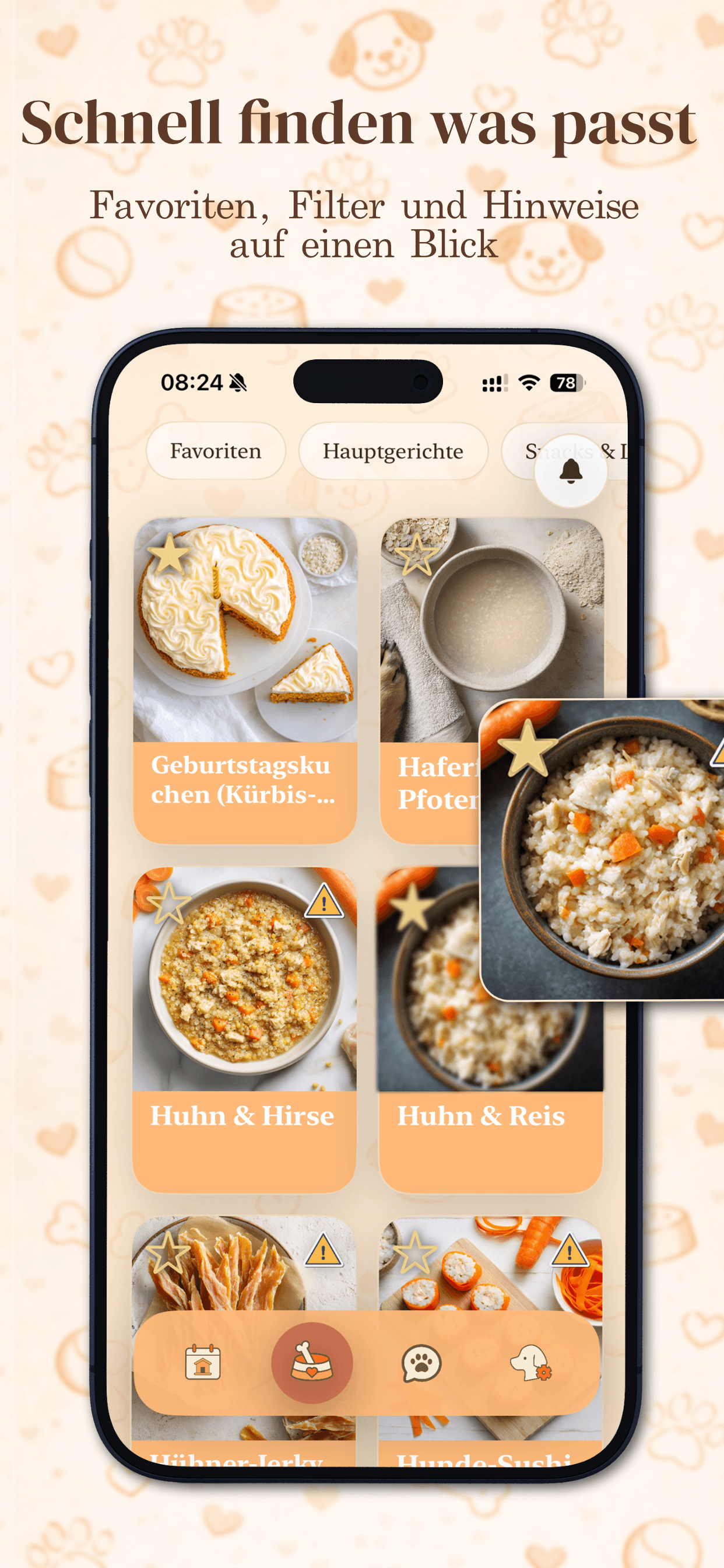
In the DoggoMeal app you create a profile for your Dobermann – with weight, age, activity and allergies. From this, the app calculates recipes with grams per ingredient, daily calories and portions.
- Dog profile
- Recipes with gram amounts
- Allergy warnings
- Cooking with video
Free · no subscription · every feature included
Common questions about feeding your Dobermann
How much food does a Dobermann need per day?
A neutered Dobermann weighing 38 kg with normal exercise needs about 1,715 kcal a day – roughly 475 g of dry food at 360 kcal per 100 g or 1,715 g of wet food. If your food has a different energy density, enter the kcal from the pack in the calculator.
How much does a Dobermann weigh?
According to the FCI standard, males weigh about 40 to 45 kg at a height at the withers of 68 to 72 cm, and females about 32 to 35 kg at 63 to 68 cm. Body shape matters more than the number: ribs palpable without pressure, waist visible from above.
Can food prevent DCM in a Dobermann?
No. In the Dobermann, DCM is genetic according to the MSD Veterinary Manual. What makes sense is a complete, fully calculated ration, a good body shape and heart examinations as agreed with your vet.
How often should I feed a Dobermann?
Adult Dobermanns get at least two meals a day, because a single large meal is considered a risk factor for bloat. Puppies get three meals a day until about six months.
How many treats can a Dobermann have?
All extras together should stay below 10% of daily calories, including chews and training rewards. Whatever you give during training comes off the daily ration.
Sources
- FCI-Standard Nr. 143: Dobermann – Fédération Cynologique Internationale (FCI)
- Dilated Cardiomyopathy in Dogs and Cats – MSD Veterinary Manual
- Gastric Dilation and Volvulus in Small Animals – MSD Veterinary Manual
- Feeding Practices in Small Animals – MSD Veterinary Manual
- Feeding treats to your dog – World Small Animal Veterinary Association (WSAVA)
Calculation method
- Nutrient Requirements of Dogs and Cats (2006) – National Research Council (NRC), National Academies Press
- Global Nutrition Guidelines – World Small Animal Veterinary Association (WSAVA)
- Nutritional Guidelines for Complete and Complementary Pet Food – FEDIAF – European Pet Food Industry Federation
Read on
Other breeds, the overview and the calculators for your dog.