Convert wet dog food to dry food – and back
175 g of dry food equals about 630 g of wet food when you go by the kcal. Enter the daily amount or the weight, plus the kcal from both packs: the calculator shows the equivalent amount and your mixing plan in grams.
Updated on
In short
You can only convert via the calories, not the weight: grams of new food = grams of old food × kcal per 100 g old ÷ kcal per 100 g new. With typical values (dry food 360, wet food 100 kcal per 100 g), 100 g of dry food replaces about 360 g of wet food, so 175 g of dry food becomes 630 g of wet food. For mixed feeding, you split the daily calories: a dog on 630 kcal gets about 90 g of dry food and 315 g of wet food half and half.
Convert wet and dry food
Enter the daily amount or the weight, plus the kcal from the packs. The result updates instantly.
Without a value, the calculator uses 360 kcal/100 g (typical: 330–400 kcal/100 g).
Without a value, the calculator uses 100 kcal/100 g (typical: 80–120 kcal/100 g).
New daily amount
630 g
Wet food instead of 175 g dry food
≈ 630 kcal a day · with 2 meals, 315 g each
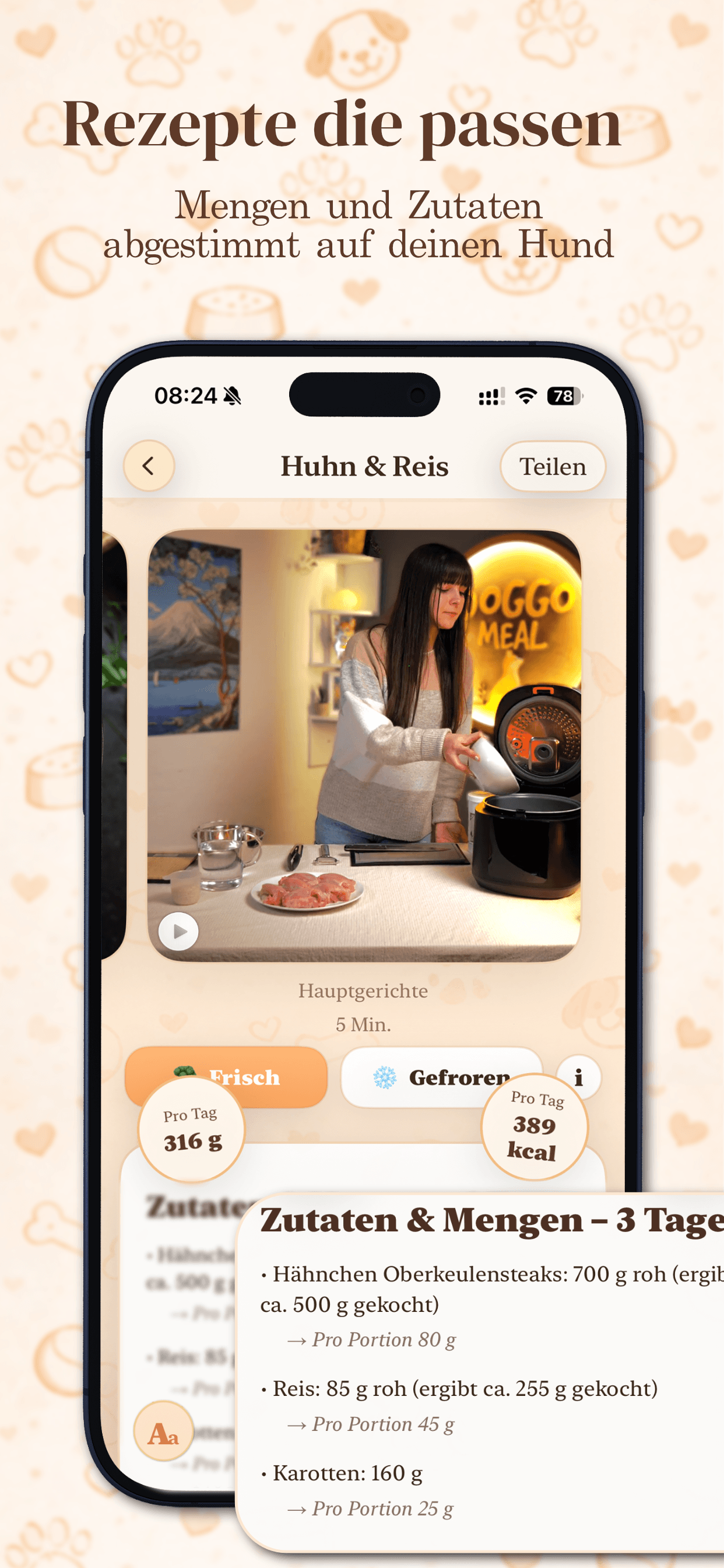
 Prefer to cook yourself?The DoggoMeal app calculates recipes in grams for your dog
- Dry food only
- 175 g
- Wet food only
- 630 g
- Conversion
- 100 g dry food ≈ 360 g wet food
- Energy
- 630 kcal a day
How the calculator works
175 g dry food × 360 kcal ÷ 100 = 630 kcal a day.
630 kcal ÷ 100 kcal × 100 ≈ 630 g wet food.
- An estimate – without values from the packs, the calculator uses averages. Enter the kcal of your foods for an exact result.
- Switch slowly: over about 7 days, starting with a quarter of new food. Sensitive dogs often need longer. Here's how: changing food the right way.
- Water: On dry food, your dog usually drinks more than on wet food. Fresh water should always be available.
- A starting point – check the weight after 1–2 weeks and adjust the amount in small steps.
Conversion chart: dry food to wet food
Dry food with 360 kcal per 100 g. Wet food usually has about 80 to 120 kcal per 100 g; some products are lower or higher. Hence three columns. Rounded to 5 g. Different values on your pack? Then use the calculator above.
| Dry food (360 kcal/100 g) | kcal | Wet food (80 kcal/100 g) | Wet food (100 kcal/100 g) | Wet food (120 kcal/100 g) |
|---|---|---|---|---|
| 50 g | 180 | 225 g | 180 g | 150 g |
| 100 g | 360 | 450 g | 360 g | 300 g |
| 150 g | 540 | 675 g | 540 g | 450 g |
| 200 g | 720 | 900 g | 720 g | 600 g |
| 250 g | 900 | 1,125 g | 900 g | 750 g |
| 300 g | 1,080 | 1,350 g | 1,080 g | 900 g |
| 400 g | 1,440 | 1,800 g | 1,440 g | 1,200 g |
| 500 g | 1,800 | 2,250 g | 1,800 g | 1,500 g |
Why you have to convert via calories
Wet food is mostly water: canned food contains 60 to over 87% moisture depending on the product, dry food only 3 to 11% (Merck Veterinary Manual). With typical values, dry food therefore has about 3.6 times as many kcal per 100 g as wet food.
Your dog needs a certain amount of energy, not a certain number of grams. If you swap gram for gram, your dog gets far too little on wet food and far too much on dry food.
Where are the kcal on the pack?
Often in the nutrition section, labelled “energy”, “metabolisable energy” or “ME”. If it says kcal per kg, divide by 10 to get kcal per 100 g.
If the energy is given in MJ per kg, multiply by 23.9: 15 MJ/kg is about 360 kcal per 100 g. If you can't find a value at all, ask the manufacturer. Until then, the calculator uses averages – so the result is only an estimate.
Mixed feeding: combining wet and dry food
When mixing, you also split the calories, not the grams. For a dog on about 630 kcal a day, that means:
- Half and half: 315 kcal from dry food (about 90 g) and 315 kcal from wet food (315 g).
- 70 to 30: about 125 g of dry food and 190 g of wet food.
- One meal wet, one meal dry: each meal gets half of the daily calories.
In the calculator, you set the ratio with the slider in 10% steps.
Switch slowly
A sudden change of food can upset the stomach. For dogs, the AAHA recommends switching over about seven days: first replace a quarter of the old food with the new one, then increase the share step by step, depending on how well your dog takes it. Sensitive dogs often need longer. Here too, the shares refer to calories.
Water: on dry food, your dog drinks more
Fresh water should always be available. Dogs that mainly eat wet food usually drink less from the bowl, because a large part of the water is already in the food (Merck Veterinary Manual). If you switch to dry food, your dog will drink more – that's normal.
If your dog suddenly drinks a lot more or less without any change in food, talk to your vet.
No current amount? Then start from the weight
Without a daily amount, the calculator estimates the requirement from the weight: resting energy requirement 70 × body weight to the power of 0.75, times 1.6 for an adult, neutered dog with normal activity. At 10 kg, that's about 630 kcal. For puppies, seniors or very active dogs, it's better to work out the kcal first with the calorie needs calculator.
How we calculate
The calculator never swaps grams for grams, only energy for energy. First it works out how many kcal your dog gets today: grams × kcal per 100 g ÷ 100. Then it converts those kcal into the other food: grams = kcal ÷ kcal per 100 g × 100.
For mixed feeding, it splits the daily calories in the chosen ratio and converts each food separately. If you don't know the current amount, it estimates the daily requirement from the weight: resting energy requirement 70 × body weight in kg to the power of 0.75, times 1.6 for an adult, neutered dog with normal activity.
Without values from the pack, it uses 360 kcal per 100 g of dry food and 100 kcal per 100 g of wet food. If the energy is given in MJ per kg: MJ/kg × 23.9 = kcal per 100 g. We round grams to the nearest gram below 50 g and to the nearest 5 g above that.
The results are starting points for healthy adult dogs. The scales and your dog's body shape show after one to two weeks whether the amount is right.
Typical energy densities
- Dry food: 360 kcal/100 g (typically 330–400 kcal/100 g)
- Wet food: 100 kcal/100 g (typically 80–120 kcal/100 g)
Sources
- Nutrient Requirements of Dogs and Cats (2006) – National Research Council (NRC), National Academies Press
- Global Nutrition Guidelines – World Small Animal Veterinary Association (WSAVA)
- Nutritional Guidelines for Complete and Complementary Pet Food – FEDIAF – European Pet Food Industry Federation
- Nutritional Requirements of Small Animals – Merck Veterinary Manual
- Tips and Timelines for Transitioning Your Pet to a New Food – American Animal Hospital Association (AAHA)
No substitute for veterinary advice, for example in the case of illness, pregnancy or marked overweight or underweight.
Frequently asked questions
How much wet food equals 100 g of dry food?
With typical values (360 kcal per 100 g of dry food, 100 kcal per 100 g of wet food) about 360 g. If your wet food has 80 kcal per 100 g, it's 450 g; at 120 kcal, 300 g. The values on your packs give the most accurate result.
How do I convert dry food into wet food?
Grams of dry food × kcal per 100 g of dry food ÷ kcal per 100 g of wet food. Example: 175 g × 360 ÷ 100 = 630 g of wet food.
How much dry food replaces 400 g of wet food?
With typical values about 110 g: 400 g × 100 ÷ 360 ≈ 110 g. Use the kcal of your two foods – the range between individual products is wide.
How do I work out the amounts for mixed feeding?
Split the daily calories, not the grams. At 630 kcal and half and half, 315 kcal come from dry food (about 90 g) and 315 kcal from wet food (315 g).
How long does switching from dry to wet food take?
Allow about a week. Start with a quarter of new food and then increase step by step, depending on how well your dog takes it. Sensitive dogs often need longer. If your dog has ongoing diarrhoea or vomits, talk to your vet.
Does my dog drink more on dry food?
Yes, usually. Wet food brings a lot of water with it, so dogs that mainly eat wet food generally drink less from the bowl. Always have fresh water available.
What if there are no kcal on the pack?
Ask the manufacturer. If the energy is given in MJ per kg, multiply by 23.9. Until then, the calculator uses averages (dry food about 330 to 400, wet food about 80 to 120 kcal per 100 g). The scales show after one to two weeks whether the amount is right.
Prefer to cook? The app works out the grams
The calculator swaps ready-made foods for each other. If you'd like to cook part of the food yourself, the DoggoMeal app works out recipes with grams per ingredient to suit your dog.
- Dog profile
- Recipes with gram amounts
- Allergy warnings
- Cooking with video
Free · no subscription · every feature included