
Can dogs eat dragon fruit?
Can my dog eat dragon fruit?In moderation
Only the flesh without the skin, in small pieces and as an occasional snack.
Yes, dogs can eat dragon fruit – in moderation and only the flesh, without the skin. The ASPCA lists the pitaya plant as non-toxic to dogs. With 68 kcal and around 12 g of sugar per 100 g, though, it's a sweet snack, so a few small cubes are enough.
How much dragon fruit can your dog eat?
Enter the weight – the amount updates straight away. You can adjust age, activity and neutering below.
How the calculator works
- Daily requirement: Resting energy requirement 70 × 15 kg^0.75 ≈ 534 kcal × factor 1.6 ≈ 855 kcal.
- Treat allowance: at most 10% of that = 86 kcal for all treats combined.
- Calorie limit: 86 kcal ÷ 68 kcal/100 g = 126 g of dragon fruit.
- Guide value for dogs 10–25 kg: 4 × cube of flesh (approx. 2 cm) at 7 g each = 28 g (cautious guide value set by our editors).
- Recommendation: the smaller of the two, rounded down to half portions → 4 × 7 g = 28 g ≈ 19 kcal.
Sources: 10% rule from the WSAVA guide to treats · kcal value: USDA FoodData Central. Daily requirement as in the dog calorie calculator.
Result · 15 kg · Adult
Up to 4
× cube of flesh (approx. 2 cm) on a snack day
(≈ 28 g, 19 kcal)
How often: As an occasional snack on the odd day, not every day. All treats together should make up no more than 10% of daily calories.
Treat allowance 86 kcal (10% of 855 kcal) · 1 cube of flesh (approx. 2 cm) ≈ 7 g
Limited by: guide value
Here the guide value for dogs 10–25 kg sets the limit (cautious guide value set by our editors): at most 4 × cube of flesh (approx. 2 cm). In terms of calories, up to 126 g would be possible.
A cautious starting value from our editorial team. The sources give no amounts for dragon fruit; according to WSAVA, all treats together stay below 10% of daily calories.
This applies if it's the only snack that day – if your dog gets other treats too, give correspondingly less.
 The app calculates recipes in grams, kcal and portions to suit your dog's weight, age, activity and allergies.
Dragon fruit for dogs: amount by weight
| Weight | Maximum per snack day | kcal |
|---|---|---|
| 5 kg | 2 × cube of flesh (approx. 2 cm)≈ 14 g | ≈ 10 |
| 10 kg | 2 × cube of flesh (approx. 2 cm)≈ 14 g | ≈ 10 |
| 20 kg | 4 × cube of flesh (approx. 2 cm)≈ 28 g | ≈ 19 |
| 30 kg | 6 × cube of flesh (approx. 2 cm)≈ 42 g | ≈ 29 |
| 40 kg | 6 × cube of flesh (approx. 2 cm)≈ 42 g | ≈ 29 |
- All snacks together no more than 10% of daily calories (WSAVA recommendation). If your dog gets other treats too, give correspondingly less.
- Guide value per weight class – small up to 10 kg, medium 10–25 kg, large over 25 kg: A cautious starting value from our editorial team. The sources give no amounts for dragon fruit; according to WSAVA, all treats together stay below 10% of daily calories.
What's in it
- The ASPCA lists the pitaya plant (Hylocereus undatus) as non-toxic to dogs.
- According to the USDA, the flesh is around 82% water and contains 1.8 g of fibre per 100 g.
- A cube of about 7 g has only around 5 kcal.
What to watch out for
- Around 12 g of sugar per 100 g: as a snack, dragon fruit is sweet, and larger amounts aren't suitable for dogs that need to lose weight.
- According to the ASPCA, any plant material can cause vomiting or digestive upset in dogs, especially if it's new to them or eaten in large amounts.
- Large pieces can be swallowed whole, especially by small and greedy dogs.
- Ready-made fruit salads, smoothies or desserts with dragon fruit often contain sugar or other ingredients that don't belong in your dog's bowl.
How to prepare dragon fruit
How to do it
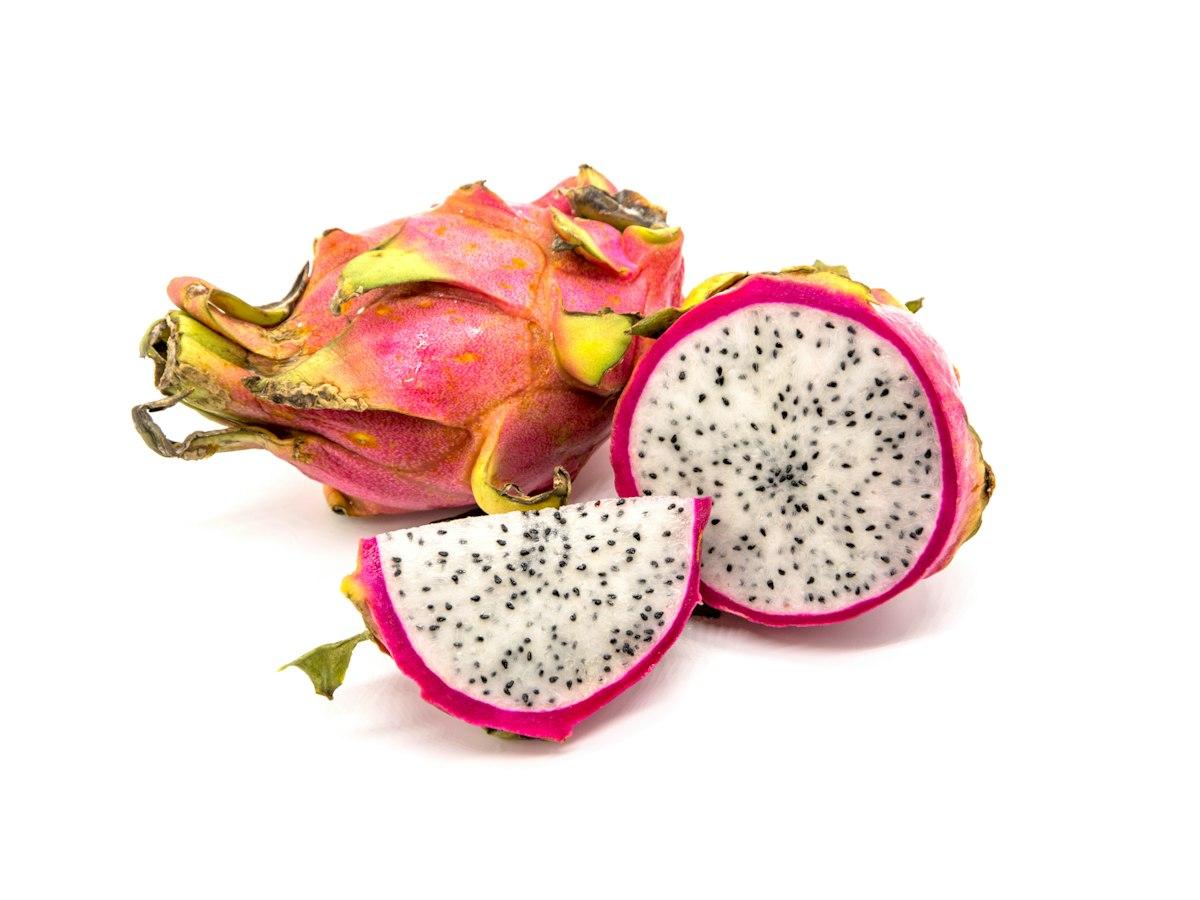
- Cut the fruit in half and scoop out the flesh with a spoon
- Cut it into small cubes
- Give it plain and fresh
- The first time, give only one cube and keep an eye on digestion
Better not
- The leathery skin
- Whole halves to gnaw on
- Fruit salad, smoothies or desserts with sugar
- Large amounts in one go
How often?
As an occasional snack on the odd day, not every day. All treats together should make up no more than 10% of daily calories.
Frequently asked questions about dragon fruit
Can my dog eat dragon fruit skin?
Only give the flesh. There's no veterinary information on the leathery skin. Scoop the flesh out with a spoon and throw the skin away out of your dog's reach.
Can my dog eat dragon fruit seeds?
The many small black seeds sit in the flesh and can't be removed. The ASPCA lists the plant as non-toxic; even so, stick to a few small cubes.
Can dogs eat red, pink, yellow or white dragon fruit?
The ASPCA has an entry for the pitaya plant Hylocereus undatus – the variety with pink skin and white flesh: non-toxic to dogs. There's no separate entry there for varieties with red or yellow flesh. Only give any variety as a small, occasional snack.
Can my dog eat dried dragon fruit?
There's no need. There's no veterinary information on dried dragon fruit, and shop-bought dried fruit is sometimes sweetened. Stick to fresh flesh in small cubes.
Can puppies eat dragon fruit?
According to the sources, a small cube of flesh is no problem for a healthy puppy. But above all, puppies need their puppy food; fruit stays an exception. At first, give only one piece and keep an eye on digestion.
How much dragon fruit can my dog eat?
A few small cubes. A cube of about 7 g has around 5 kcal. The calculator on this page shows exactly how much is right; doggomeal.de/en/kalorienbedarf-hund-rechner works out your dog's daily needs. All treats together stay below 10% of daily calories.
Is dragon fruit toxic to dogs?
No. The ASPCA lists the pitaya plant (Hylocereus undatus) as non-toxic to dogs. Like any plant material, though, it can cause vomiting or diarrhoea in larger amounts.
What should I do if my dog has eaten a lot of dragon fruit?
Usually it doesn't go beyond digestive upset. Keep an eye on your dog and call your vet if they vomit several times, have severe diarrhoea, seem lethargic or have swallowed skin and large pieces.
Similar foods
- In moderationFruitMangoRipe flesh only, without the stone or skin, in small pieces.See the answer
- In moderationFruitPineappleFresh flesh only, without the skin, core and crown.See the answer
- In moderationFruitKiwiPeeled, in small pieces and only as an occasional snack.See the answer
- YesFruitWatermelonOnly the flesh, without the seeds or rind, in small cubes.See the answer
- NoFruitPomegranateNot toxic, but the seeds can cause vomiting and diarrhoea; never the rind or stem.See the answer
- In moderationFruitBananaPeeled, sliced and, because of the sugar, only as a small snack.See the answer
Sources
- Toxic and Non-Toxic Plants: Night Blooming Cereus (Pitaya, Hylocereus undatus) – ASPCA Animal Poison Control Center
- Toxic and Non-Toxic Plants List – ASPCA Animal Poison Control Center
- Feeding treats to your dog – WSAVA Global Nutrition Committee
- Dragon fruit (Survey (FNDDS), FDC 2709234) – USDA FoodData Central
Updated: · DoggoMeal editorial team
This page is no substitute for veterinary advice. Dogs with pre-existing conditions – for example of the kidneys, liver or pancreas, or with diabetes – and dogs with allergies often need their own rules. If your dog has symptoms or you're unsure, ask your vet.
Recipes that fit your dog
DoggoMeal is an app for iPhone and Android: you create a profile for your dog, choose a recipe, and the app calculates grams, kcal and portions to suit your dog's weight, age, activity and allergies.
- Dog profile
- Recipes with gram amounts
- Allergy warnings
- Cooking with video
Free · no subscription · every feature included