
Can dogs eat apricots?
Can my dog eat apricots?In moderation
Only the flesh; never the stone, stalk or leaves, and no dried apricots as treats.
Yes, dogs can eat apricots – but only the flesh, in small pieces. The stone, stalk and leaves contain hydrogen cyanide precursors, and a swallowed stone can block the intestine as a foreign body. According to the USDA, dried apricots have around five times as many calories as fresh ones and a great deal of sugar, so they are not suitable as treats.
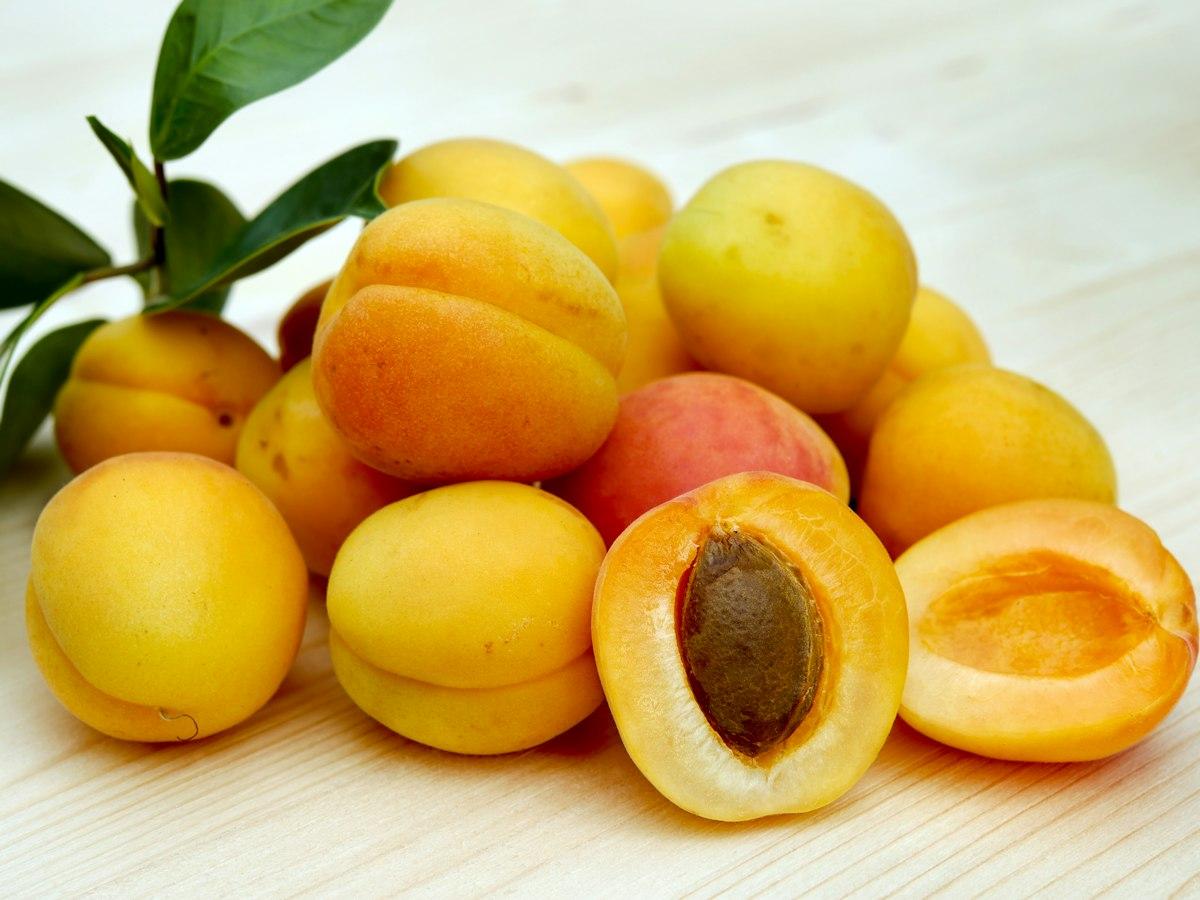
How much apricot can your dog eat?
Enter the weight – the amount updates straight away. You can adjust age, activity and neutering below.
How the calculator works
- Daily requirement: Resting energy requirement 70 × 15 kg^0.75 ≈ 534 kcal × factor 1.6 ≈ 855 kcal.
- Treat allowance: at most 10% of that = 86 kcal for all treats combined.
- Calorie limit: 86 kcal ÷ 48 kcal/100 g = 179 g of apricots.
- Guide value for dogs 10–25 kg: 2 × slice (⅛ of an apricot, stone removed) at 4.4 g each = 9 g (cautious guide value set by our editors).
- Recommendation: the smaller of the two, rounded down to half portions → 2 × 4.4 g = 8 g ≈ 4 kcal.
Sources: 10% rule from the WSAVA guide to treats · kcal value: USDA FoodData Central. Daily requirement as in the dog calorie calculator.
Result · 15 kg · Adult
Up to 2
× slice (⅛ of an apricot, stone removed) on a snack day
(≈ 8 g, 4 kcal)
How often: Occasionally one or two slices as a snack during apricot season, not every day. All treats together should make up no more than 10% of daily calories.
Treat allowance 86 kcal (10% of 855 kcal) · 1 slice (⅛ of an apricot, stone removed) ≈ 4.4 g
Limited by: guide value
Here the guide value for dogs 10–25 kg sets the limit (cautious guide value set by our editors): at most 2 × slice (⅛ of an apricot, stone removed). In terms of calories, up to 179 g would be possible.
None of our sources gives an amount. We stay cautious: no more than half an apricot (around 35 g per fruit according to the USDA) for large dogs.
This applies if it's the only snack that day – if your dog gets other treats too, give correspondingly less.
 The app calculates recipes in grams, kcal and portions to suit your dog's weight, age, activity and allergies.
Apricots for dogs: amount by weight
| Weight | Maximum per snack day | kcal |
|---|---|---|
| 5 kg | 1 slice (⅛ of an apricot, stone removed)≈ 4 g | ≈ 2 |
| 10 kg | 1 slice (⅛ of an apricot, stone removed)≈ 4 g | ≈ 2 |
| 20 kg | 2 × slice (⅛ of an apricot, stone removed)≈ 8 g | ≈ 4 |
| 30 kg | 4 × slice (⅛ of an apricot, stone removed)≈ 17 g | ≈ 8 |
| 40 kg | 4 × slice (⅛ of an apricot, stone removed)≈ 17 g | ≈ 8 |
- All snacks together no more than 10% of daily calories (WSAVA recommendation). If your dog gets other treats too, give correspondingly less.
- Guide value per weight class – small up to 10 kg, medium 10–25 kg, large over 25 kg: None of our sources gives an amount. We stay cautious: no more than half an apricot (around 35 g per fruit according to the USDA) for large dogs.
Emergency note
Swallowed or chewed an apricot stone?
A swallowed apricot stone can block the stomach or intestine as a foreign body, and the kernel inside also contains cyanide. Call your vet, and don't try to make your dog vomit yourself.
Possible symptoms
- Vomiting or gagging
- Loss of appetite
- Abdominal pain
- Diarrhoea, or straining with little stool
- Lethargy
- Difficulty breathing or heavy panting
- Brick-red mucous membranes or dilated pupils
When to see a vet?
Call your vet straight away if your dog has swallowed or chewed an apricot stone, even if it still seems lively. If there is difficulty breathing, brick-red mucous membranes, seizures or repeated vomiting, go to your vet or an animal hospital immediately.
In an emergency: call your vet or an animal hospital
Outside opening hours, an emergency vet service or an animal hospital can help. Note down the amount, the time and the packaging, and don't try to make your dog vomit yourself. Poison information centres mainly advise on poisoning in people and only help with animals when they have capacity – the first point of contact for your dog is your vet.
What's in it
- According to Pet Poison Helpline, the flesh provides vitamins, minerals and antioxidants.
- Per 100 g according to the USDA: 2 g fibre, 96 µg vitamin A, 10 mg vitamin C and 259 mg potassium.
- Around 48 kcal per 100 g – one slice (⅛ of an apricot) provides only about 2 kcal.
What to watch out for
- The stone is a foreign body: your dog can choke on it, and once swallowed it can block the stomach or intestine.
- The stone, stalk and leaves contain cyanogenic glycosides, from which hydrogen cyanide forms. According to the ASPCA, wilting leaves are particularly toxic.
- According to the ASPCA, signs of cyanide poisoning are brick-red mucous membranes, dilated pupils, difficulty breathing, panting and shock; Pet Poison Helpline says they can appear 15 to 20 minutes after eating.
- Dried apricots are very high in sugar: according to the USDA, 241 kcal and 53.4 g sugar per 100 g, compared with 48 kcal and 9.2 g for fresh ones.
- Tinned apricots in syrup still have 18.6 g sugar per 100 g when drained, apricot jam 43.4 g.
- “Sugar-free” jam or yoghurt can contain xylitol (birch sugar), which dangerously lowers blood sugar in dogs.
How to prepare apricots
How to do it
- Wash the apricot, halve it and remove the stone
- Remove the stalk and leaves completely
- Cut into thin slices or small cubes
- Dispose of stones straight away, out of your dog's reach
- The first time, give just one slice and watch how your dog tolerates it
Better not
- Whole apricots or the stone to play with
- Apricot kernels, including shop-bought ones sold as snacks
- Dried apricots as treats
- Tinned apricots in syrup and apricot jam
- “Sugar-free” jam or fruit yoghurt with xylitol
- Leaves and twigs from the apricot tree to chew on
How often?
Occasionally one or two slices as a snack during apricot season, not every day. All treats together should make up no more than 10% of daily calories.
Frequently asked questions about apricots
Can my dog eat an apricot stone?
No. The stone can get stuck in the throat or block the intestine, and according to the ASPCA the kernel, stalk and leaves contain cyanide. Only give your dog the flesh, with the stone removed.
Can dogs eat dried apricots?
Better not as a treat. According to the USDA, dried apricots have 241 kcal and 53.4 g sugar per 100 g, around five times as much energy as fresh ones. Pet Poison Helpline also advises restraint because of the sugar. Give a fresh slice instead.
Can dogs eat tinned apricots?
Better not. According to the USDA, tinned apricots in syrup still have 18.6 g sugar per 100 g when drained, twice as much as fresh ones. Use fresh apricots with the stone removed.
Can my dog eat apricot jam?
No. According to the USDA, apricot jam has 43.4 g sugar per 100 g. “Sugar-free” versions can contain xylitol; the Merck Veterinary Manual advises always checking the ingredient list when a product says “sugar-free”.
Can my dog eat apricot yoghurt?
It's best to leave out shop-bought apricot yoghurt. Versions labelled “no sugar” can contain xylitol, which dangerously lowers blood sugar in dogs. If you want to give apricot, give fresh slices on their own.
Can dogs eat apricots, peaches and nectarines?
Yes, following the same rules: only flesh with the stone removed, in small pieces. The ASPCA lists peach, plum and cherry in the same group as apricot. More at doggomeal.de/en/darf-mein-hund/pfirsich and doggomeal.de/en/darf-mein-hund/nektarine.
How many apricot stones are dangerous for a dog?
None of our sources gives a safe number. Even a single stone can block the intestine as a foreign body, and the kernel inside contains cyanide. So call your vet after any swallowed stone.
Are apricot tree leaves toxic to dogs?
Yes. According to the ASPCA, stems, leaves and seeds contain cyanide, and wilting leaves are particularly toxic. Don't let your dog chew on twigs or fallen leaves.
How much apricot is too much?
A little is enough as a snack: a 10 kg dog can have about 1 slice. According to WSAVA, all treats together should make up no more than 10% of daily calories. doggomeal.de/en/kalorienbedarf-hund-rechner works out your dog's daily needs.
Similar foods
- In moderationFruitPeachFresh flesh without the stone, stalk and leaves, in small pieces.See the answer
- In moderationFruitNectarineOnly the flesh in small pieces; the stone must always come out.See the answer
- In moderationFruitPlumOnly the flesh, stone removed, in small pieces; the stone is dangerous.See the answer
- In moderationFruitCherryOnly a few, without stones or stalks; stones, stalks and leaves are toxic.See the answer
- In moderationFruitDatePitted only and just a small piece now and then, as dried dates are very high in sugar.See the answer
- In moderationFruitMangoRipe flesh only, without the stone or skin, in small pieces.See the answer
Sources
- Toxic and Non-toxic Plants: Apricot – ASPCA Animal Poison Control Center
- Can Dogs Have Apricots? – Pet Poison Helpline
- Ingestion of Foreign Bodies in Dogs – VCA Animal Hospitals
- Xylitol Toxicosis in Dogs – Merck Veterinary Manual
- WSAVA Guide to Treats for Dogs – World Small Animal Veterinary Association (WSAVA)
- Vergiftung beim Hund: Richtig helfen – aber wie? (Presseinformation 30/2012) – Bundestierärztekammer
- Apricots, raw (SR Legacy, FDC 171697) – USDA FoodData Central
- Apricots, dried, sulfured, uncooked (SR Legacy, FDC 173941) – USDA FoodData Central
- Apricots, canned, heavy syrup, drained (SR Legacy, FDC 167768) – USDA FoodData Central
- Jams and preserves, apricot (SR Legacy, FDC 170645) – USDA FoodData Central
Updated: · DoggoMeal editorial team
This page is no substitute for veterinary advice. Dogs with pre-existing conditions – for example of the kidneys, liver or pancreas, or with diabetes – and dogs with allergies often need their own rules. If your dog has symptoms or you're unsure, ask your vet.
Recipes that fit your dog
DoggoMeal is an app for iPhone and Android: you create a profile for your dog, choose a recipe, and the app calculates grams, kcal and portions to suit your dog's weight, age, activity and allergies.
- Dog profile
- Recipes with gram amounts
- Allergy warnings
- Cooking with video
Free · no subscription · every feature included