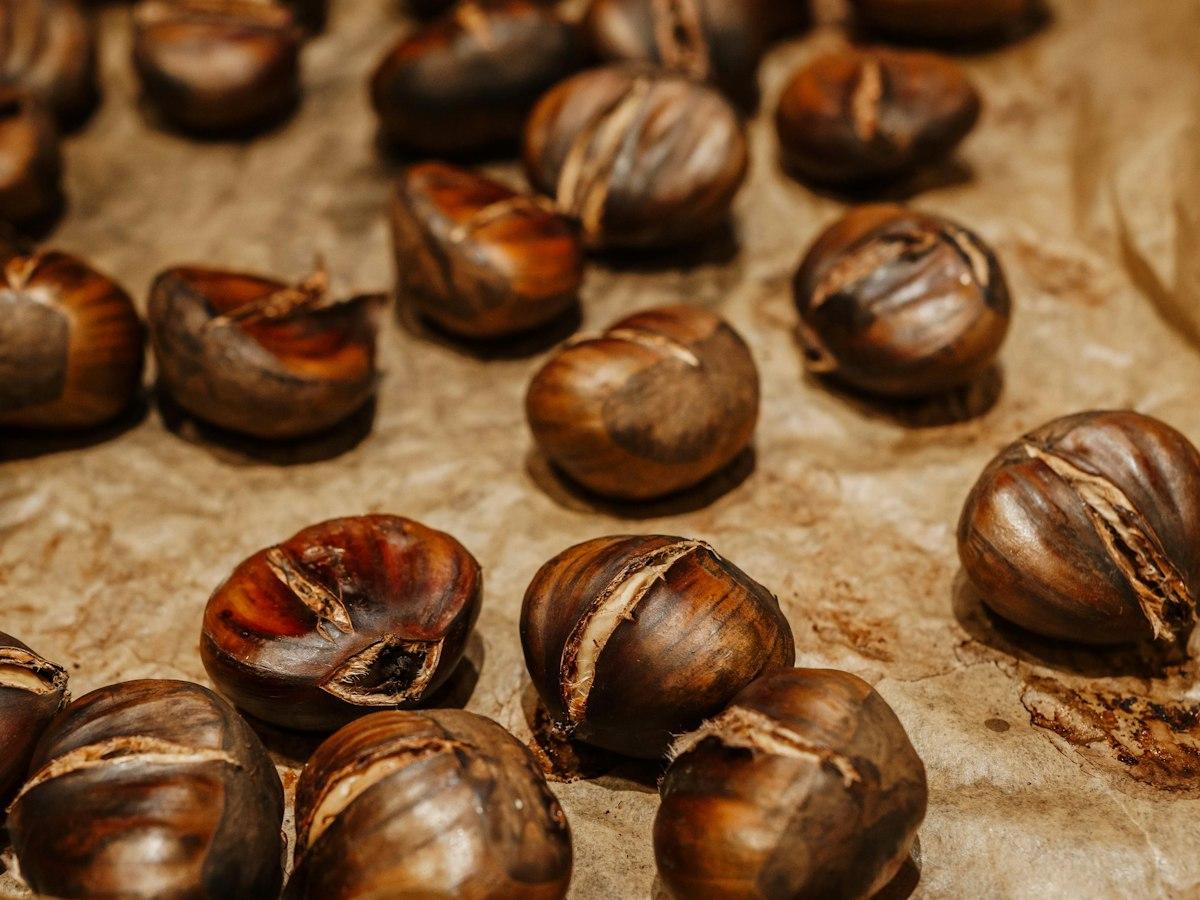
Can dogs eat chestnuts?
Can my dog eat chestnuts?In moderation
Cooked, peeled, unsalted, one to three. Horse chestnuts (conkers) are toxic.
Yes, dogs can eat sweet chestnuts in small amounts, boiled or roasted, peeled and without salt or sugar. If your dog has eaten a horse chestnut (conker) on a walk, however, call your vet: horse chestnuts come from a different tree, are toxic to dogs and can block the gut. Sweet chestnuts are starchy, roasted around 245 kcal per 100 g, so one to three at most. Sweetened chestnut purée and candied chestnuts aren't suitable.
How many chestnuts can your dog eat?
Enter the weight – the amount updates straight away. You can adjust age, activity and neutering below.
How the calculator works
- Daily requirement: Resting energy requirement 70 × 15 kg^0.75 ≈ 534 kcal × factor 1.6 ≈ 855 kcal.
- Treat allowance: at most 10% of that = 86 kcal for all treats combined.
- Calorie limit: 86 kcal ÷ 245 kcal/100 g = 35 g of chestnuts.
- Guide value for dogs 10–25 kg: 2 × chestnut (cooked, peeled) at 8 g each = 16 g (cautious guide value set by our editors).
- Recommendation: the smaller of the two, rounded down to half portions → 2 × 8 g = 16 g ≈ 39 kcal.
Sources: 10% rule from the WSAVA guide to treats · kcal value: USDA FoodData Central. Daily requirement as in the dog calorie calculator.
Result · 15 kg · Adult
Up to 2
× chestnut (cooked, peeled) on a snack day
(≈ 16 g, 39 kcal)
How often: Only now and then, for example at Christmas time. All treats together at most 10% of daily calories.
Treat allowance 86 kcal (10% of 855 kcal) · 1 chestnut (cooked, peeled) ≈ 8 g
Limited by: guide value
Here the guide value for dogs 10–25 kg sets the limit (cautious guide value set by our editors): at most 2 × chestnut (cooked, peeled). In terms of calories, up to 35 g would be possible.
No veterinary amount found. Cautious editorial rule: 1, 2 or 3 chestnuts per weight class, calculated with the calories of roasted chestnuts so the amount also fits roasted chestnuts from a Christmas market.
This applies if it's the only snack that day – if your dog gets other treats too, give correspondingly less.
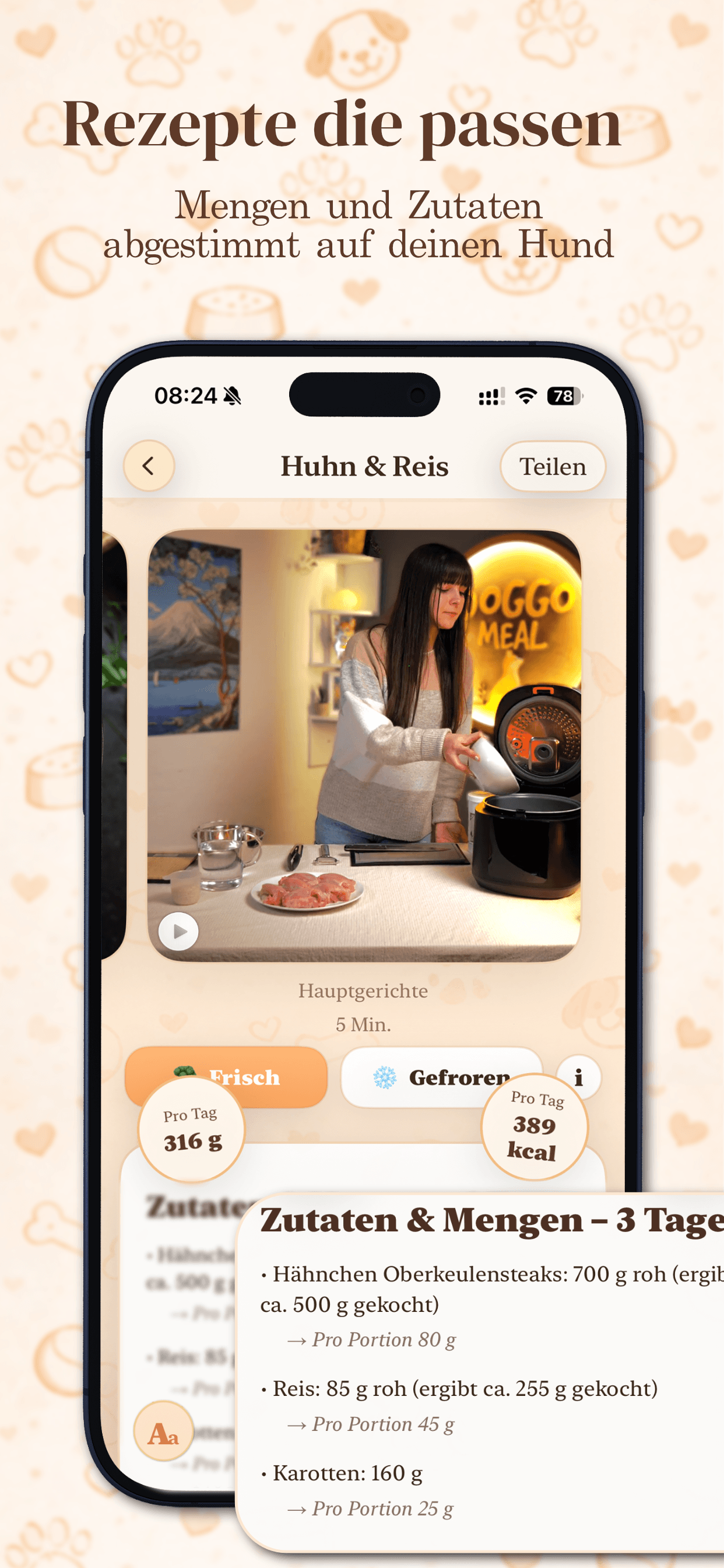
 The app calculates recipes in grams, kcal and portions to suit your dog's weight, age, activity and allergies.
Chestnuts for dogs: amount by weight
| Weight | Maximum per snack day | kcal |
|---|---|---|
| 5 kg | 1 chestnut (cooked, peeled)≈ 8 g | ≈ 20 |
| 10 kg | 1 chestnut (cooked, peeled)≈ 8 g | ≈ 20 |
| 20 kg | 2 × chestnut (cooked, peeled)≈ 16 g | ≈ 39 |
| 30 kg | 3 × chestnut (cooked, peeled)≈ 24 g | ≈ 59 |
| 40 kg | 3 × chestnut (cooked, peeled)≈ 24 g | ≈ 59 |
- All snacks together no more than 10% of daily calories (WSAVA recommendation). If your dog gets other treats too, give correspondingly less.
- Guide value per weight class – small up to 10 kg, medium 10–25 kg, large over 25 kg: No veterinary amount found. Cautious editorial rule: 1, 2 or 3 chestnuts per weight class, calculated with the calories of roasted chestnuts so the amount also fits roasted chestnuts from a Christmas market.
Emergency note
Has your dog eaten a horse chestnut (conker)?
Call your vet as soon as your dog has eaten or chewed a horse chestnut, even if they still seem lively. Don't make your dog sick yourself; according to the Kennel Club, that can be dangerous. Horse chestnuts contain saponins and aesculin, which mainly irritate the lining of the stomach and gut, and a whole conker can block the stomach or gut. If possible, take a conker with you to the vet. If your dog has only taken a cooked, peeled sweet chestnut from the table, it isn't an emergency.
Possible symptoms
- Vomiting, sometimes with blood
- Diarrhoea
- Tummy pain
- Drooling
- Strong thirst
- Loss of appetite
- Restlessness
- Staggering or an unsteady gait
- Tremors
- Dilated pupils and drowsiness
When to see a vet?
Call straight away, don't wait for symptoms. According to CliniTox, the first signs appear after 1 to 3 hours, according to the Kennel Club usually after 1 to 6 hours, and rarely only after a few days. The leaves, bark and flowers of the horse chestnut are toxic too. If your dog vomits repeatedly or stops eating, a conker may also be stuck in the stomach or gut.
From what amount?
According to CliniTox (University of Zurich), just 1 to 2 seeds are enough to cause signs of poisoning in dogs and cats. The Kennel Club stresses that the toxin content varies from tree to tree and from year to year, so no safe number can be given. Because conkers taste bitter, most dogs don't eat enough for severe poisoning. Call your vet anyway, whatever the amount.
In an emergency: call your vet or an animal hospital
Outside opening hours, an emergency vet service or an animal hospital can help. Note down the amount, the time and the packaging, and don't try to make your dog vomit yourself. Poison information centres mainly advise on poisoning in people and only help with animals when they have capacity – the first point of contact for your dog is your vet.
What's in it
- The ASPCA lists the American chestnut (Castanea dentata), a close relative of the sweet chestnut, as non-toxic to dogs.
- Compared with other nuts, sweet chestnuts are low in fat but rich in starch.
- Provide potassium, fibre and some vitamin C.
- Peeled and cut small, they make an occasional reward at Christmas time.
What to watch out for
- Horse chestnuts are not sweet chestnuts. According to the University of Goettingen, the horse chestnut isn't related to the sweet chestnut, and its fruits are inedible. They are toxic to dogs: they contain saponins (aescin) and aesculin.
- According to CliniTox (University of Zurich), just 1 to 2 horse chestnuts can cause signs of poisoning in a dog or cat: vomiting, diarrhoea, tummy pain and staggering, and in severe cases tremors, paralysis and an intestinal blockage.
- Whole chestnuts are large and hard. For horse chestnuts, the Kennel Club warns that they can get stuck in the throat or block the stomach and gut. Give sweet chestnuts only peeled and cut small too.
- The leathery shell and the thin seed skin underneath don't belong in the bowl.
- Sweet chestnuts are starchy: roasted around 245 kcal per 100 g, boiled around 131 kcal. Too many contribute to weight gain.
- Sweetened chestnut purée, chestnut cream for desserts and candied or glazed chestnuts are confectionery and not suitable for dogs.
- Chestnuts from a goose stuffing aren't plain: if there are onions, spices or roasting fat in the stuffing, the same applies to the chestnuts in it. doggomeal.de/darf-mein-hund/zwiebeln explains why onions are toxic to dogs.
- In German, “Maronen” can also mean a woodland mushroom, the bay bolete. Mushrooms are hard to identify reliably, and some are fatally toxic to dogs.
How to prepare chestnuts
How to do it
- Use only shop-bought chestnuts or sweet chestnuts you have identified for certain
- Boil or roast them without salt
- Remove the shell and the thin seed skin completely
- Let them cool and cut them small or mash them
- The first time, give just one piece and watch the digestion
- Keep your dog on a lead on walks under horse chestnut trees
Better not
- Horse chestnuts, including for playing or throwing
- Whole chestnuts or shells
- Salted, sugared or candied chestnuts
- Sweetened chestnut purée or chestnut cream
- Chestnuts from the stuffing of a roast goose or duck
- Raw chestnuts
How often?
Only now and then, for example at Christmas time. All treats together at most 10% of daily calories.
Frequently asked questions about chestnuts
Can dogs eat boiled or roasted chestnuts?
Yes, in small amounts. That's how sweet chestnuts are prepared for people too. Peel them completely, let them cool and cut them small. Depending on size, one to three are enough.
Can dogs eat raw chestnuts?
Better to give them cooked. According to the University of Goettingen, sweet chestnuts are eaten roasted or boiled, and the veterinary sources say nothing about raw chestnuts. Whole and in their shells, they're too big and too hard anyway.
Can dogs eat hot chestnuts from a Christmas market?
One peeled, cooled roasted chestnut, yes. Remove the shell and seed skin completely, then cut it small. Sugared or candied chestnuts aren't suitable.
Can dogs eat chestnut purée or chestnut cream?
Not the sweet kinds. Chestnut purée and chestnut cream are sweetened for desserts, candied and glazed chestnuts are confectionery, and your dog doesn't need sugar. If the ingredients list only chestnuts, the same applies as for boiled chestnuts: only a little.
Can my dog eat chestnuts from the goose stuffing?
Better not. Chestnuts are often used as a stuffing for goose, but the stuffing isn't plain: it's seasoned and soaks up roasting fat. If there are onions in it, it's off limits. doggomeal.de/en/darf-mein-hund/zwiebeln explains why they're toxic. What's fine from a roast goose is at doggomeal.de/en/darf-mein-hund/gans.
Can dogs eat bay bolete mushrooms?
In German these mushrooms are also called “Maronen” because of their brown cap, but they have nothing to do with sweet chestnuts. According to the Pet Poison Helpline, mushrooms are hard to identify reliably, a job for experts. If your dog eats a mushroom, treat it as poisoning and call your vet straight away.
Can dogs play with chestnuts?
Not with horse chestnuts. They're toxic and big enough for a dog to choke on. The Kennel Club advises keeping your dog on a lead under horse chestnut trees and bringing a ball or a chew toy instead.
Can puppies eat chestnuts?
A small piece of cooked, peeled sweet chestnut isn't toxic for a puppy, but it isn't necessary. Never give whole chestnuts. Keep puppies especially well away from horse chestnuts in autumn.
How do I tell sweet chestnuts from horse chestnuts?
Both lie under the tree in spiky husks in autumn and are shiny brown, which makes them easy to confuse. The leaves tell them apart reliably: the horse chestnut has large, hand-shaped leaves made up of five or seven leaflets, the sweet chestnut simple, long, narrow leaves with a toothed edge. Horse chestnuts are roundish, smooth seeds, while sweet chestnuts end in a small, hairy tip. Horse chestnuts often grow in parks, gardens and along streets. If you're unsure, don't give your dog any chestnuts you've collected.
How many calories does a chestnut have?
Roasted, around 245 kcal per 100 g; boiled, around 131 kcal. A roasted, peeled chestnut of about 8 g therefore has around 20 kcal. The treat limit for a 10 kg dog with normal needs is around 63 kcal a day. doggomeal.de/en/kalorienbedarf-hund-rechner works out your dog's needs.
How many horse chestnuts are toxic to a dog?
There's no safe number. CliniTox gives just 1 to 2 seeds as a toxic amount for dogs and cats, and the Kennel Club points out that the toxin content varies from tree to tree. On top of that, a whole conker can block the gut. So call your vet whatever the amount.
Are chestnuts nuts? Does the nuts page apply?
Botanically, sweet chestnuts are nuts, but compared with other nuts they have little fat and a lot of starch. Which nuts are risky or toxic for dogs is at doggomeal.de/en/darf-mein-hund/nuesse.
What else can my dog eat at Christmas?
A few plain ingredients such as peeled chestnuts, unseasoned red cabbage or boiled potatoes are fine in small amounts. What's off limits from the festive table and how to cook your dog a Christmas meal of its own is at doggomeal.de/en/magazin/was-duerfen-hunde-an-weihnachten-essen and doggomeal.de/en/magazin/weihnachtsessen-fuer-hunde.
Similar foods
- Not neededNuts & seedsNutsMany are fatty and some toxic; never macadamias or mouldy nuts.See the answer
- In moderationMeatGooseA small piece of cooked meat without skin, gravy or bones. No roast leftovers.See the answer
- In moderationVegetablesRed cabbagePlain cooked, very finely chopped, a little. Not from a jar or from the festive plate.See the answer
- In moderationVegetablesBrussels sproutsCooked until soft, chopped small, unseasoned. Not raw, whole or fried.See the answer
- In moderationVegetablesPotatoOnly cooked and peeled; raw, green and sprouting potatoes contain solanine.See the answer
- YesVegetablesSweet potatoCooked and peeled; raw sweet potato and the skin are hard to digest.See the answer
Sources
- Toxic and Non-Toxic Plants: Chestnut – ASPCA Animal Poison Control Center
- CliniTox Pflanzengifte: Aesculus hippocastanum – Institut für Veterinärpharmakologie und -toxikologie, Universität Zürich
- Are conkers poisonous to dogs? – The Royal Kennel Club
- Castanea sativa / Edelkastanie: Biologie – Forstbotanischer Garten, Universität Göttingen
- Esskastanien als Nahrungsmittel – Forstbotanischer Garten, Universität Göttingen
- Mushrooms – Pet Poison Helpline
- Maronen-Röhrling – Wikipedia
- Gewöhnliche Rosskastanie – Wikipedia
- Edelkastanie – Wikipedia
- Nuts, chestnuts, european, roasted (SR Legacy, FDC 170190) – USDA FoodData Central (kcal value)
- Feeding treats to your dog – WSAVA Global Nutrition Committee (10% rule in the calculator)
Updated: · DoggoMeal editorial team
This page is no substitute for veterinary advice. Dogs with pre-existing conditions – for example of the kidneys, liver or pancreas, or with diabetes – and dogs with allergies often need their own rules. If your dog has symptoms or you're unsure, ask your vet.
Recipes that fit your dog
DoggoMeal is an app for iPhone and Android: you create a profile for your dog, choose a recipe, and the app calculates grams, kcal and portions to suit your dog's weight, age, activity and allergies.
- Dog profile
- Recipes with gram amounts
- Allergy warnings
- Cooking with video
Free · no subscription · every feature included