
Can dogs eat duck?
Can my dog eat duck?In moderation
Cooked duck meat without skin, bones or seasoning, in small pieces.
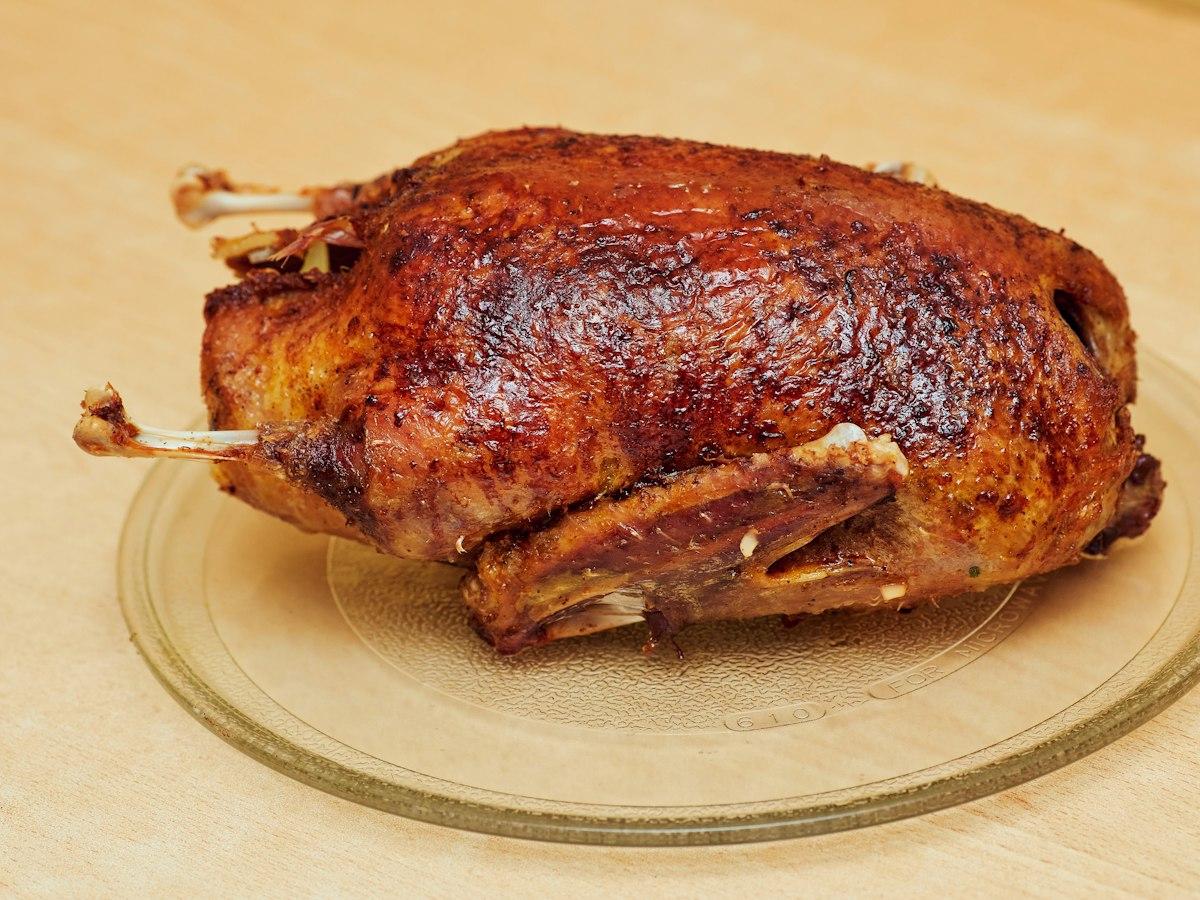
In moderation: cooked duck meat without skin, bones or seasoning is fine in small amounts. If your dog has got hold of duck bones or roast duck leftovers, watch it closely and call your vet if it vomits, has abdominal pain, is constipated or seems lethargic. The German Federal Chamber of Veterinarians says goose and duck bones are sharp and splinter easily, and roast leftovers are often too fatty and heavily seasoned and don't belong in the bowl. With skin, cooked duck has over twice the fat.
How much duck can your dog eat?
Enter the weight – the amount updates straight away. You can adjust age, activity and neutering below.
How the calculator works
- Daily requirement: Resting energy requirement 70 × 15 kg^0.75 ≈ 534 kcal × factor 1.6 ≈ 855 kcal.
- Treat allowance: at most 10% of that = 86 kcal for all treats combined.
- Calorie limit: 86 kcal ÷ 201 kcal/100 g = 43 g of duck.
- Guide value for dogs 10–25 kg: 2 × tablespoon of duck meat (cooked, chopped small) at 9 g each = 18 g (cautious guide value set by our editors).
- Recommendation: the smaller of the two, rounded down to half portions → 2 × 9 g = 18 g ≈ 36 kcal.
Sources: 10% rule from the WSAVA guide to treats · kcal value: USDA FoodData Central. Daily requirement as in the dog calorie calculator.
Result · 15 kg · Adult
Up to 2
× tablespoon of duck meat (cooked, chopped small) on a snack day
(≈ 18 g, 36 kcal)
How often: Now and then a small piece in the amount shown by the calculator, not daily. If duck is the protein source in your dog's food, the food's amounts apply, not this snack amount. All treats together should make up no more than 10% of daily calories.
Treat allowance 86 kcal (10% of 855 kcal) · 1 tablespoon of duck meat (cooked, chopped small) ≈ 9 g
Limited by: guide value
Here the guide value for dogs 10–25 kg sets the limit (cautious guide value set by our editors): at most 2 × tablespoon of duck meat (cooked, chopped small). In terms of calories, up to 43 g would be possible.
A cautious editorial guide, because there is no veterinary amount for duck and the meat is fatty. 1 tablespoon ≈ 9 g (USDA: 1 cup of diced duck meat = 140 g).
This applies if it's the only snack that day – if your dog gets other treats too, give correspondingly less.
 The app calculates recipes in grams, kcal and portions to suit your dog's weight, age, activity and allergies.
Duck for dogs: amount by weight
| Weight | Maximum per snack day | kcal |
|---|---|---|
| 5 kg | 1 tablespoon of duck meat (cooked, chopped small)≈ 9 g | ≈ 18 |
| 10 kg | 1 tablespoon of duck meat (cooked, chopped small)≈ 9 g | ≈ 18 |
| 20 kg | 2 × tablespoon of duck meat (cooked, chopped small)≈ 18 g | ≈ 36 |
| 30 kg | 3 × tablespoon of duck meat (cooked, chopped small)≈ 27 g | ≈ 54 |
| 40 kg | 3 × tablespoon of duck meat (cooked, chopped small)≈ 27 g | ≈ 54 |
- All snacks together no more than 10% of daily calories (WSAVA recommendation). If your dog gets other treats too, give correspondingly less.
- Guide value per weight class – small up to 10 kg, medium 10–25 kg, large over 25 kg: A cautious editorial guide, because there is no veterinary amount for duck and the meat is fatty. 1 tablespoon ≈ 9 g (USDA: 1 cup of diced duck meat = 140 g).
Emergency note
Got hold of duck bones or roast duck leftovers?
Cooked duck bones are sharp and splinter easily, and they can seriously injure the stomach. Larger amounts of bone can cause painful constipation. Skin and fat from the roast can cause diarrhoea, and after a very fatty meal pancreatitis too. Take any leftovers away from your dog if you can do so without a tussle, and watch it closely over the next few days.
Possible symptoms
- Vomiting
- Diarrhoea
- Abdominal pain, often with the praying position: rear end up, head and front legs on the floor
- Lethargy
- Loss of appetite
- Fever
- Constipation, no faeces or very hard faeces
When to see a vet?
If your dog has swallowed a larger piece of bone, call your vet the same day, even if it seems fine. If it gags, vomits repeatedly or struggles to breathe, go to your vet or an animal hospital immediately. If it has abdominal pain, a fever, seems lethargic or can't pass faeces, have it examined promptly.
In an emergency: call your vet or an animal hospital
Outside opening hours, an emergency vet service or an animal hospital can help. Note down the amount, the time and the packaging, and don't try to make your dog vomit yourself. Poison information centres mainly advise on poisoning in people and only help with animals when they have capacity – the first point of contact for your dog is your vet.
What's in it
- Provides protein: according to the USDA, 100 g of cooked skinless duck meat has around 23 g of protein.
- Contains iron, zinc, selenium and niacin.
- Not one of the most common triggers of food allergies in dogs. The Merck Veterinary Manual lists those as beef, dairy products, chicken, wheat and lamb.
What to watch out for
- Lots of fat: cooked without skin, duck meat has around 11 g of fat per 100 g, with skin just over 28 g. Not every dog tolerates fatty food, and diarrhoea and even pancreatitis are possible.
- Roast duck leftovers don't belong in the bowl: according to the German Federal Chamber of Veterinarians, they are often far too fatty and heavily seasoned.
- Cooked duck bones are sharp and splinter easily, and they can seriously injure the stomach. Larger amounts of bone can lead to painful constipation with so-called bone faeces.
- Raw or dried bones such as duck necks and duck feet can also lead to broken teeth, blockages of the oesophagus or gut, and constipation.
- Raw poultry can carry salmonella and Campylobacter. People in the household can be infected through the food or the dog's faeces, young children, pregnant people, older people and those who are ill in particular.
- Duck liver only rarely and in small amounts: if a dog is fed mainly liver, it can develop vitamin A poisoning. Duck foie gras and liver pâtés are out altogether: they are very fatty and salty, and goose liver pâté, for example, has around 44 g of fat per 100 g according to the USDA.
How to prepare duck
How to do it
- Use duck breast without skin, or remove the skin before cooking
- Cook it in water without salt, stock cubes or seasoning
- Cook it all the way through, even though duck breast is often served pink for people
- Let it cool, chop it small and check for bone splinters
- After handling raw poultry, clean your hands, the board and the knife with hot water and washing-up liquid
- The first time, give only a little and watch for diarrhoea
Better not
- Duck skin or duck fat
- Bones, including necks, wings or feet, cooked or raw
- Roast duck leftovers, gravy or stuffing
- Salt, onion, garlic or seasoning
- Raw duck or raw duck liver
- Liver in large amounts or every day
How often?
Now and then a small piece in the amount shown by the calculator, not daily. If duck is the protein source in your dog's food, the food's amounts apply, not this snack amount. All treats together should make up no more than 10% of daily calories.
Frequently asked questions about duck
Can dogs eat raw duck?
Better not. Raw poultry can carry salmonella and Campylobacter, which are dangerous for people too. According to the WSAVA, people in the household can be infected through the food or the dog's faeces. Freezing or drying doesn't kill all bacteria. So only give duck that is cooked all the way through.
Can dogs eat duck bones?
No. According to the German Federal Chamber of Veterinarians, cooked goose and duck bones are sharp and splinter easily, and they can seriously injure the stomach. If a dog eats larger amounts of bone, painful constipation can follow. Raw bones can also lead to broken teeth, blockages of the oesophagus or gut, and constipation. More on this: doggomeal.de/en/magazin/rohe-knochen-fuer-hunde.
Duck necks for dogs: raw, cooked or dried?
Not cooked, because cooked duck bones splinter. Raw or dried, a neck is still a bone: the WSAVA lists broken teeth, blockages of the oesophagus or gut, and constipation. Drying doesn't kill all bacteria either. So we advise against duck necks, even under supervision: it neither stops a piece from getting stuck nor prevents an infection with germs.
Can dogs eat duck feet or duck wings?
These contain bones too, so the same applies as for the neck: never cooked, and we advise against raw or dried ones too. Your dog doesn't get wings or legs from the festive roast.
Can dogs eat duck skin or roast duck?
No. According to the USDA, cooked duck with skin has just over 28 g of fat per 100 g, without skin around 11 g. Roast duck leftovers don't belong in the bowl: the German Federal Chamber of Veterinarians says they are often far too fatty and heavily seasoned. Fatty food can cause diarrhoea and even pancreatitis. Onion from gravy and stuffing is off limits too: doggomeal.de/en/darf-mein-hund/zwiebeln explains why it is toxic to dogs.
Can dogs eat duck liver?
Cooked, rarely and in small amounts yes, raw no. Liver supplies vitamin A, and if a dog is fed mainly liver, it can develop vitamin A poisoning. This is rare in dogs, but large amounts still don't belong in the bowl. Amounts and preparation are on doggomeal.de/en/darf-mein-hund/leber. Don't give duck foie gras or liver pâté.
Can dogs eat duck eggs?
Hard-boiled yes, raw no. Raw duck eggs can carry Salmonella, and raw egg white contains avidin, which binds biotin; cooking inactivates it. Cook duck eggs until both the white and the yolk are firm; according to the Food Safety Authority of Ireland they need longer than hen's eggs. Otherwise duck eggs follow the same rules as hen's eggs: doggomeal.de/en/darf-mein-hund/eier.
Is duck good for dogs with food allergies?
It can be an option if your dog has never had it before. For an elimination diet, the protein has to be new to your dog, and Merck advises avoiding species that are similar to ones fed before where possible. During the diet your dog gets nothing else, not even chews or food from the table. Plan it with your vet. More on this: doggomeal.de/en/magazin/hund-mit-allergien.
How much duck can my dog eat?
As an extra on top of the food, a little is enough: the calculator on this page gives a 10 kg dog 1 tablespoon (9 g) of cooked skinless meat, which is around 18 kcal. A 30 kg dog gets 3 tablespoons (27 g). The amounts are deliberately small because duck is fatty and there is no veterinary amount for it.
My dog has diarrhoea after eating duck – can't it tolerate it?
It may be the fat: many dogs tolerate fatty food, others get diarrhoea. A food allergy can show up on the skin, with itching, hair loss and recurring skin and ear infections. If the diarrhoea continues, or your dog vomits or seems lethargic, see your vet. How a bland diet works is explained on doggomeal.de/en/schonkost-hund-rechner.
Are dried duck breast treats OK?
They count as treats like everything else, and all treats together should stay below 10% of daily calories. Drying doesn't kill all bacteria, so wash your hands after feeding them. During an elimination diet, treats like these are off limits too.
Can puppies eat duck?
A puppy doesn't need duck. If anything, a tiny piece of cooked meat without skin, bones or seasoning. It shouldn't have raw poultry, and homemade raw food can be unbalanced, which the WSAVA says is especially harmful to puppies. doggomeal.de/en/welpen-futtermenge-rechner works out the daily amount of its food.
What does my dog get at Christmas instead of roast duck?
Its own food, ideally at the same time as your meal. What's fine from the festive table and what isn't is in doggomeal.de/en/magazin/was-duerfen-hunde-an-weihnachten-essen, and a festive meal for dogs is in doggomeal.de/en/magazin/weihnachtsessen-fuer-hunde.
Similar foods
- In moderationMeatGooseA small piece of cooked meat without skin, gravy or bones. No roast leftovers.See the answer
- YesMeatChickenThoroughly cooked, without skin, bones or seasoning, as a small extra on top of the food.See the answer
- In moderationMeatLiverThoroughly cooked and unseasoned; sparingly as an extra, not unlimited daily.See the answer
- In moderationOtherEggOnly fully cooked, without salt or fat, and no more than once or twice a week.See the answer
- In moderationVegetablesRed cabbagePlain cooked, very finely chopped, a little. Not from a jar or from the festive plate.See the answer
- Not neededGrains & sidesDumplingsSalted, and bread dumplings often contain onion. A piece of potato dumpling is no emergency.See the answer
Sources
- Gefahren unterm Weihnachtsbaum (Presseinformation 26/2016) – Bundestierärztekammer
- BARFen – aber richtig! (Presseinformation 22/2016) – Bundestierärztekammer
- Pancreatitis in Dogs – VCA Animal Hospitals
- Raw Meat Based Diets for Pets – WSAVA Global Nutrition Committee
- Cutaneous Food Allergy in Animals – Merck Veterinary Manual
- Nutritional Requirements of Small Animals – Merck Veterinary Manual
- Duck, domesticated, meat and skin, cooked, roasted (SR Legacy, FDC 172409) – USDA FoodData Central
- Pate de foie gras, canned (goose liver pate), smoked (SR Legacy, FDC 171100) – USDA FoodData Central
- Advice on duck eggs – Food Safety Authority of Ireland (FSAI)
- Duck, domesticated, meat only, cooked, roasted (SR Legacy, FDC 172411) – USDA FoodData Central (kcal value)
- Feeding treats to your dog – WSAVA Global Nutrition Committee (10% rule in the calculator)
Updated: · DoggoMeal editorial team
This page is no substitute for veterinary advice. Dogs with pre-existing conditions – for example of the kidneys, liver or pancreas, or with diabetes – and dogs with allergies often need their own rules. If your dog has symptoms or you're unsure, ask your vet.
Recipes that fit your dog
DoggoMeal is an app for iPhone and Android: you create a profile for your dog, choose a recipe, and the app calculates grams, kcal and portions to suit your dog's weight, age, activity and allergies.
- Dog profile
- Recipes with gram amounts
- Allergy warnings
- Cooking with video
Free · no subscription · every feature included