No-bake dog treats: frozen yoghurt drops
No oven, no dough: plain yoghurt and a ripe banana are blended until smooth, poured into a silicone mould with small cavities and frozen. After three hours the drops are firm. Because they have to stay in the freezer, they are treats for home rather than for your coat pocket on a walk.
Updated on
- Per biscuit
- ≈ 3.5 kcal
- Makes
- approx. 70 biscuits
- Total time
- 3 hr 15 min
Ingredients
for approx. 70 biscuits (50–90 depending on the mould)
The switch converts grams and the number of biscuits. ≈ 3.5 kcal per piece – that stays the same.
Total mixture approx. 350 g · Shape: small hearts or paws, approx. 2 cm. Weigh the ingredients and only fill the cavities to the rim – bigger pieces have correspondingly more kcal.
0 of 2 ingredients ready – tick off what you have.
Ingredients checked
How to make yoghurt drops
6 steps
- Check the yoghurt pot: the ingredients list should show only milk and yoghurt cultures – no sugar, no sweetener, no xylitol, no fruit and no flavourings.
- Mash the banana finely with a fork and blend it with the yoghurt using a stick blender until smooth.
- Pour the mixture into a silicone mould with small cavities, such as a chocolate or ice cube mould with hearts or paws of around 2 cm, and smooth the top. Without a mould, pipe small dots onto a board lined with baking paper. With Greek yoghurt, they hold their shape better.
- Place the mould level in the freezer and leave to freeze solid for at least 3 hours.
- Press the frozen drops out of the mould and keep them in a well-sealed, labelled freezer container.
- Before feeding, let them thaw for a minute or two so they are no longer rock hard. Give them one at a time.
Freezer
Freezer, −18 °C
Freezing time
3 hr
Prep
15 min
Did your dog enjoy it?
No ratings yet – how did your dog like it?
No sign-up needed. We only store the stars and a checksum against double votes, never your IP address. Privacy
Makes approx. 70 biscuits at ~3.5 kcal each
One piece weighs about 5 g. Nutrient values per 100 g from USDA FoodData Central (SR Legacy) (FDC number under each ingredient); water has no kcal. If you end up with more or fewer pieces, divide the 242 kcal by your number.
| Ingredient | Amount | kcal/100 g | kcal |
|---|---|---|---|
| Plain yoghurt, 3.5% fat (no sugar, no xylitol)USDA FDC 171284 | 250 g | 61 | 153 |
| Ripe banana, peeledUSDA FDC 173944 | 100 g | 89 | 89 |
| Total ÷ 70 biscuits | 242 ÷ 70 = 3.5 | ||
Biscuit calculator: the most biscuits that fit into a biscuit day
Enter weight, age and exercise – the number of biscuits updates instantly.
- Yoghurt contains lactose, which many dogs digest poorly. To keep the amount of yoghurt below the guideline on our yoghurt page (5, 10 and 15 g a day depending on size), the drops have their own daily cap. No more than 1 biscuit a day for dogs up to 10 kg, 2 for dogs of 10–25 kg and 4 for dogs over 25 kg. More on this: Can dogs eat yoghurt?
- If your dog gets other treats or chews that day, give fewer biscuits accordingly.
- Reduce the daily ration by these 3 kcal – that's about 1 g of dry food.
How the number is worked out
Resting energy requirement 70 × 10 kg^0.75 ≈ 394 kcal × factor 1.6 ≈ 630 kcal a day. No more than 10% of that for treats = 63 kcal. 63 kcal ÷ 3.5 kcal per biscuit = 18.2 → rounded down to 18 biscuits. Cap for dogs up to 10 kg (because of the lactose): 1 biscuit; the lower number applies.
The 10% rule comes from the WSAVA's guidance on treats.
Result · Adult
Up to 1 biscuit
Yoghurt drops a day
Cap because of the lactose: by calories alone it would be 18.
Treat budget 63 kcal (10% of 630 kcal) · 1 biscuit ≈ 3.5 kcal
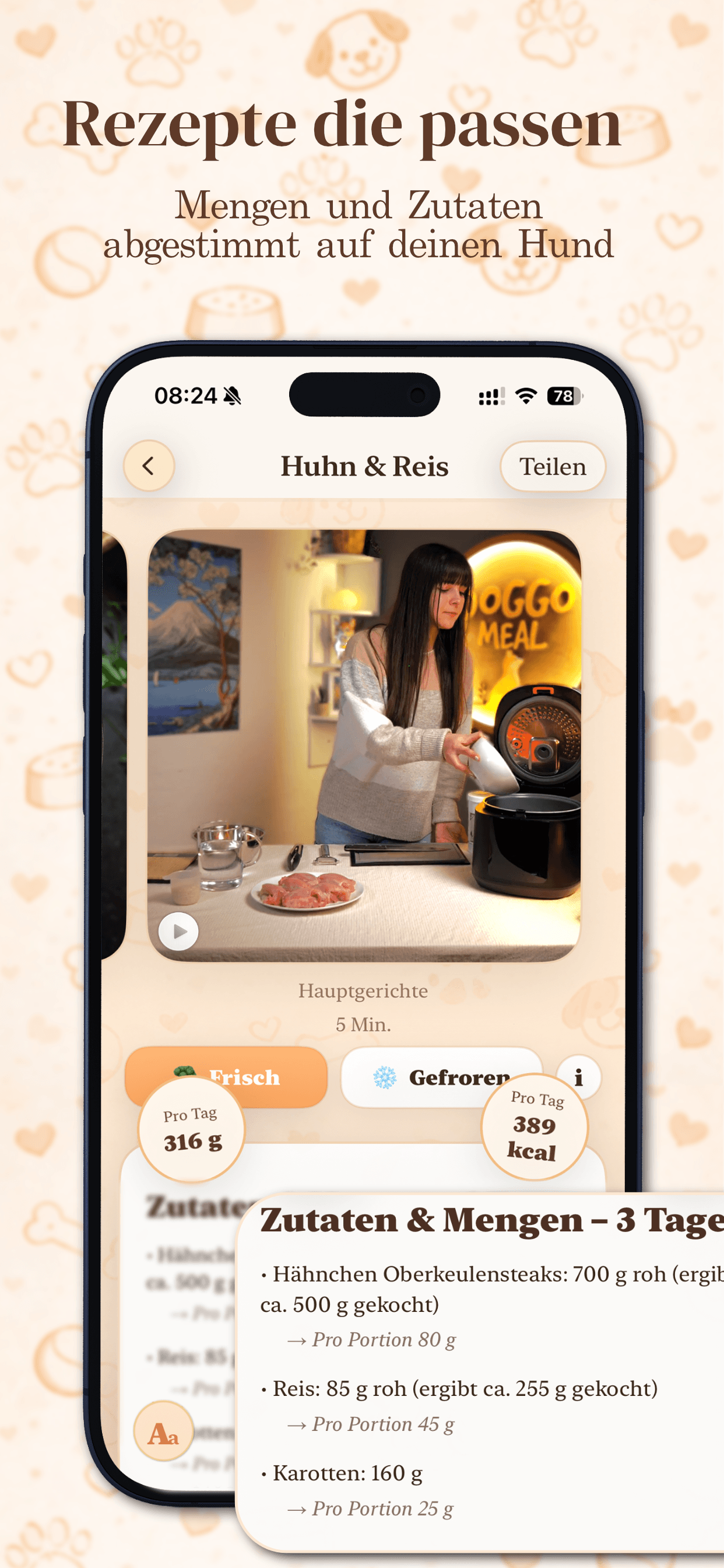
 The DoggoMeal app works out main meals in grams per ingredient to suit your dog.
Storage · about 4 weeks in the freezer
The drops stay in the freezer until you feed them, well sealed at −18 °C. For the best flavour and texture, use them within about four weeks. Don't refreeze drops that have thawed.
If a biscuit smells musty or sour or shows any mould, throw out the whole tin: according to the Merck Veterinary Manual, mould toxins can cause tremors and seizures in dogs.
Suits
- No oven
- Grain-free
- Egg-free
- Meat-free
Contains
- Milk (yoghurt)
- Banana
Important for this recipe
- Only use yoghurt without sugar, sweeteners or xylitol. According to PetMD, xylitol can cause severe liver damage, dangerously low blood sugar and death in dogs. If your dog has eaten yoghurt containing xylitol, go to your vet or an emergency vet straight away rather than waiting to see what happens.
- Yoghurt contains lactose, which many dogs digest poorly; too much can cause vomiting and diarrhoea. That's why dogs up to 10 kg get no more than 1 drop a day, dogs of 10–25 kg 2 and larger dogs 4, even if the calories would allow more. The first time, give just one drop and watch how your dog's digestion copes.
- Choose a size that suits your dog: according to WSAVA, treats should be a size and shape that your dog won't choke on.
- Always off-limits: sugar, salt, xylitol, chocolate, raisins, onion, garlic, macadamia nuts, nutmeg, alcohol and coffee – see all the basic rules.
Frequently asked questions
How many yoghurt drops can my dog have a day?
One biscuit has about 3.5 kcal. Under the 10% rule for treats, a neutered, normally active dog weighing 5 kg would get 11 biscuits a day, a 10 kg dog 18 biscuits and a 25 kg dog 36 biscuits. Yoghurt contains lactose, which many dogs digest poorly. To keep the amount of yoghurt below the guideline on our yoghurt page (5, 10 and 15 g a day depending on size), the drops have their own daily cap. No more than 1 biscuit a day for dogs up to 10 kg, 2 for dogs of 10–25 kg and 4 for dogs over 25 kg. So that's 1 biscuit a day at 5 kg, 1 biscuit at 10 kg and 2 biscuits at 25 kg. The biscuit calculator on this page works it out for your dog.
Which dog treats can you make without baking?
Anything that sets in the cold: drops of plain yoghurt and banana like these, or small ice cubes made from cooked, puréed chicken liver and water. Because of all the vitamin A, use liver sparingly: about 5 g a day for dogs up to 10 kg, 10 g for 10–25 kg and 15 g for larger dogs. Balls of raw rolled oats, on the other hand, are not a good idea: according to the AKC, raw oats are harder for dogs to digest, so they should be cooked or baked.
How long do no-bake dog treats keep?
These drops only keep frozen. Well sealed in the freezer, they stay good for about four weeks; after that, flavour and texture suffer. Outside the freezer they soften quickly, so only take out as many as you are about to feed.
Can I use Greek yoghurt?
Yes. According to PetMD, Greek yoghurt contains more protein and less lactose than regular yoghurt. It is higher in fat, though: according to the USDA, whole-milk Greek yoghurt has 97 kcal and 5 g of fat per 100 g, regular whole-milk yoghurt 61 kcal and 3.3 g of fat. That gives each drop just over 1 kcal more.
Related reading
Sources
- PetMD: Can Dogs Eat Yogurt?
- American Kennel Club (AKC): Can Dogs Eat Oatmeal?
- WSAVA Global Nutrition Committee: Feeding treats to your dog
You might also like these
Bake biscuits, keep track of the daily ration
The DoggoMeal app knows your dog's weight, age and activity and shows recipes for main meals with grams per ingredient.
- Dog profile
- Recipes with gram amounts
- Allergy warnings
- Cooking with video
Free · no subscription · every feature included