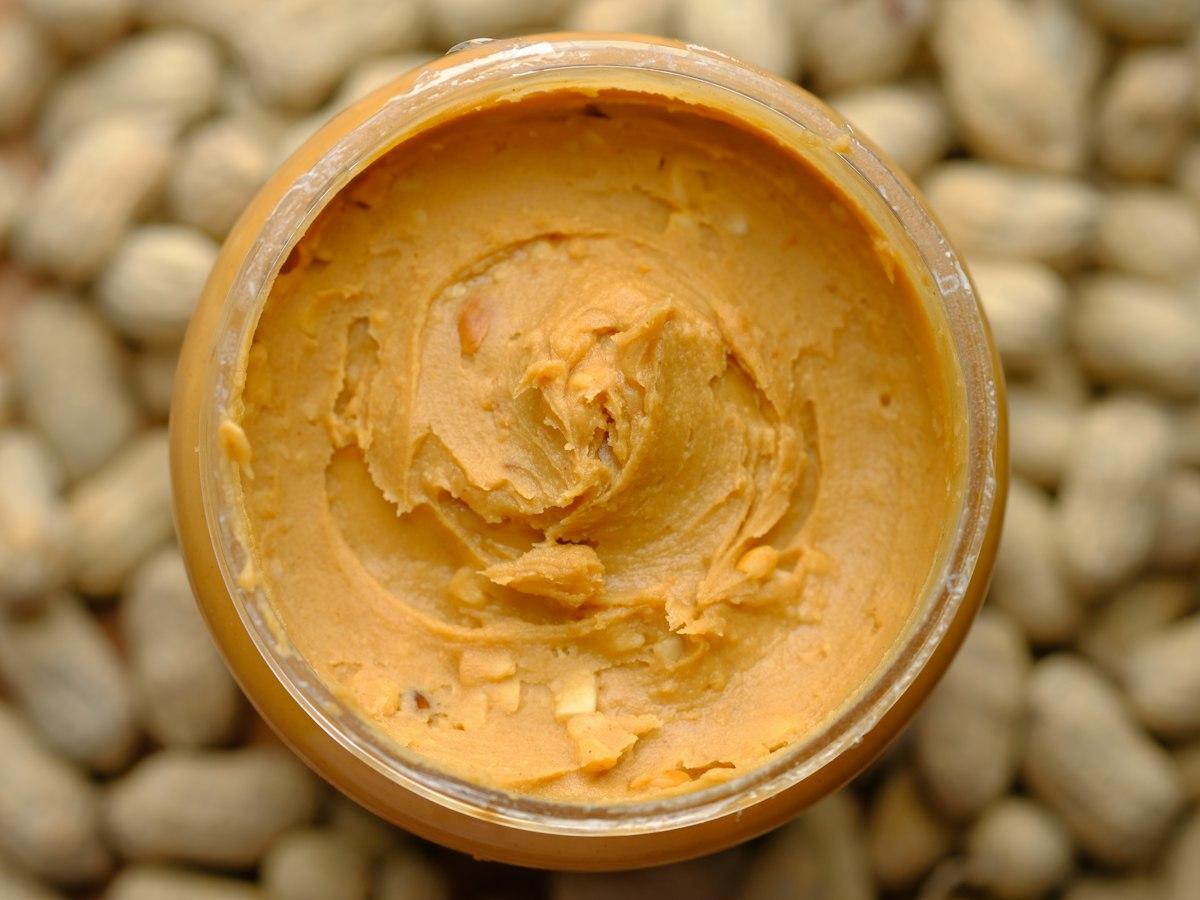
Can dogs eat peanut butter?
Can my dog eat peanut butter?In moderation
Only pure peanut butter without xylitol, sugar or salt, spread thinly and not every day.
Yes, dogs can eat peanut butter – but only pure peanut butter made from 100% peanuts, without xylitol, sugar or salt. Xylitol (birch sugar) is toxic to dogs and is found in some brands, so check the ingredient list every time. Peanut butter is very high in calories and fat: depending on size, half to one and a half level teaspoons, spread thinly on a lick mat or in a chew toy, is enough as an occasional reward.
How much peanut butter can your dog eat?
Enter the weight – the amount updates straight away. You can adjust age, activity and neutering below.
How the calculator works
- Daily requirement: Resting energy requirement 70 × 15 kg^0.75 ≈ 534 kcal × factor 1.6 ≈ 855 kcal.
- Treat allowance: at most 10% of that = 86 kcal for all treats combined.
- Calorie limit: 86 kcal ÷ 598 kcal/100 g = 14 g of peanut butter.
- Guide value for dogs 10–25 kg: 1 × level teaspoon (approx. 5 g) at 5 g each = 5 g (cautious guide value set by our editors).
- Recommendation: the smaller of the two, rounded down to half portions → 1 × 5 g = 5 g ≈ 30 kcal.
Sources: 10% rule from the WSAVA guide to treats · kcal value: USDA FoodData Central. Daily requirement as in the dog calorie calculator.
Result · 15 kg · Adult
Up to 1
level teaspoon (approx. 5 g) on a snack day
(≈ 5 g, 30 kcal)
How often: Only now and then as a special reward, not daily, and alternated with other treats. All treats together should be no more than 10% of daily calories. Even in home-baked treats, peanut butter stays a small ingredient.
Treat allowance 86 kcal (10% of 855 kcal) · 1 level teaspoon (approx. 5 g) ≈ 5 g
Limited by: guide value
Here the guide value for dogs 10–25 kg sets the limit (cautious guide value set by our editors): at most 1 level teaspoon (approx. 5 g). In terms of calories, up to 14 g would be possible.
Editorial guideline; the weight per teaspoon is an estimate. PetMD gives ½ teaspoon to 1 tablespoon depending on size; we stay below that and only advise occasional servings.
This applies if it's the only snack that day – if your dog gets other treats too, give correspondingly less.
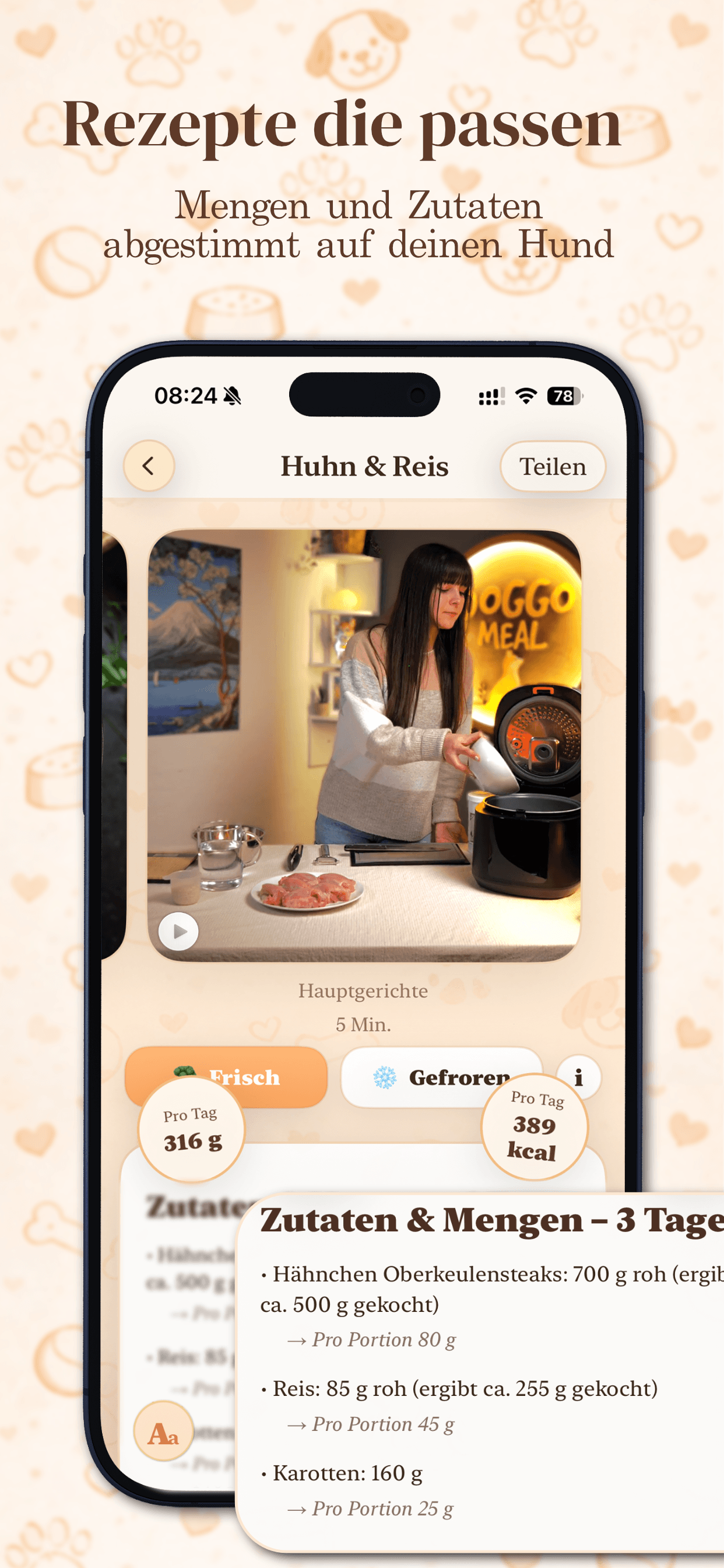
 The app calculates recipes in grams, kcal and portions to suit your dog's weight, age, activity and allergies.
Peanut butter for dogs: amount by weight
| Weight | Maximum per snack day | kcal |
|---|---|---|
| 5 kg | ½ level teaspoon (approx. 5 g)≈ 2 g | ≈ 12 |
| 10 kg | ½ level teaspoon (approx. 5 g)≈ 2 g | ≈ 12 |
| 20 kg | 1 level teaspoon (approx. 5 g)≈ 5 g | ≈ 30 |
| 30 kg | 1½ × level teaspoon (approx. 5 g)≈ 7 g | ≈ 42 |
| 40 kg | 1½ × level teaspoon (approx. 5 g)≈ 7 g | ≈ 42 |
- All snacks together no more than 10% of daily calories (WSAVA recommendation). If your dog gets other treats too, give correspondingly less.
- Guide value per weight class – small up to 10 kg, medium 10–25 kg, large over 25 kg: Editorial guideline; the weight per teaspoon is an estimate. PetMD gives ½ teaspoon to 1 tablespoon depending on size; we stay below that and only advise occasional servings.
Emergency note
Eaten peanut butter with xylitol?
Call your vet or an animal hospital immediately if the peanut butter contained xylitol (birch sugar), even if your dog still seems fine. Take the jar with you or note the ingredients, the amount and the time. If your dog got hold of pure peanut butter without xylitol, an upset stomach is the main risk.
Possible symptoms
- Vomiting
- Weakness and lethargy
- Staggering or an unsteady gait
- Collapse
- Seizures
When to see a vet?
After xylitol, go immediately – do not wait for symptoms. According to the AKC, low blood sugar can set in as soon as 10 to 60 minutes after eating, and according to the Merck Veterinary Manual some dogs develop severe liver damage. After a lot of pure peanut butter, call your vet as soon as your dog vomits or has tummy pain.
In an emergency: call your vet or an animal hospital
Outside opening hours, an emergency vet service or an animal hospital can help. Note down the amount, the time and the packaging, and don't try to make your dog vomit yourself. Poison information centres mainly advise on poisoning in people and only help with animals when they have capacity – the first point of contact for your dog is your vet.
What's in it
- According to the AKC, it contains protein, fat, vitamins B and E and niacin.
- Many dogs love the taste, so a dab works well as a special reward, for example during a bath or grooming.
- Spread thinly in a chew toy or on a lick mat, it keeps your dog busy for a while.
- A level teaspoon (approx. 5 g) has around 30 kcal (598 kcal per 100 g).
What to watch out for
- Some peanut butter contains xylitol (birch sugar). Even small amounts can lower a dog's blood sugar dangerously and damage the liver.
- Products labelled “no added sugar” or “sugar-free” in particular can contain xylitol. According to the AKC, low blood sugar can set in as soon as 10 to 60 minutes after eating.
- Peanut butter is very high in fat and calories: 598 kcal and 51.4 g of fat per 100 g. Too much leads to weight gain and can trigger pancreatitis.
- According to PetMD, dogs with pancreatitis or on a low-fat diet should not have peanut butter unless your vet approves it. If your dog has diabetes, ask your vet first.
- Salted peanut butter contains a lot of sodium, which can be a problem for dogs.
- Allergic reactions are rare, for example red, itchy skin, hives, vomiting, diarrhoea or swelling of the face.
How to prepare peanut butter
How to do it
- Check the ingredient list: peanuts only, without xylitol, sugar, salt or palm oil
- Spread it thinly on a lick mat or in a chew toy
- Give only a tiny amount the first time and watch your dog
- Keep all treats together to no more than 10% of daily calories
Better not
- Peanut butter with xylitol, birch sugar or other sweeteners
- Salted or sweetened peanut butter
- Protein or fitness peanut butter with sweetener
- Spoonfuls straight from the jar
- Peanut butter for dogs with pancreatitis without checking with your vet
How often?
Only now and then as a special reward, not daily, and alternated with other treats. All treats together should be no more than 10% of daily calories. Even in home-baked treats, peanut butter stays a small ingredient.
Frequently asked questions about peanut butter
Can dogs eat peanuts?
Only unsalted, dry-roasted peanuts without the shell, and according to the AKC only a few, not every day. Peanuts are too high in fat for regular treats. Your dog should not have salted, honey-roasted or seasoned peanuts, and the shell can make small dogs in particular choke.
Can dogs eat peanut butter with sugar?
Better not. According to the AKC, the best choice is peanut butter without salt and without added sugar. Be careful with “no added sugar” or “sugar-free”: these products can contain xylitol, which is toxic to dogs.
Can my dog eat regular shop-bought peanut butter?
According to the AKC, most brands are not toxic, but many contain salt, sugar or other additives. Read the ingredient list every time: ideally it says only “peanuts”. If it contains xylitol or birch sugar, it is off limits.
Can dogs eat crunchy peanut butter?
Yes. According to PetMD, the same rules apply to crunchy as to smooth peanut butter: without xylitol or other unsafe ingredients, in small amounts and only occasionally.
Can my dog lick peanut butter?
Yes, in small amounts. Let your dog lick a dab off a spoon, or spread the peanut butter thinly in a chew toy or on a lick mat. Licking out the jar is too much, and check the ingredients for xylitol first.
Is peanut butter with birch sugar toxic to dogs?
Yes. Birch sugar is another name for xylitol, which can lower a dog's blood sugar dangerously and damage the liver. Call your vet immediately. More at doggomeal.de/en/darf-mein-hund/xylit.
How much peanut butter can my dog eat?
For small dogs, half a level teaspoon is enough, for large dogs about one and a half, and only now and then. All treats together should make up no more than 10% of daily calories. Your dog's daily needs are worked out by doggomeal.de/en/kalorienbedarf-hund-rechner.
Can puppies eat peanut butter?
Ask your vet first. Peanut butter is very high in fat, and according to PetMD, whether a new food suits your dog also depends on age. If your vet gives the go-ahead, a tiny amount without xylitol is enough.
Is peanut butter good for dogs?
It contains protein, fat, vitamin E, B vitamins and niacin, but according to PetMD it is not a major source of nutrition. Its value lies mainly in the fact that dogs love it and that it works well as a reward or for enrichment.
Can I bake dog biscuits with peanut butter?
Yes, with pure peanut butter without sugar, salt or xylitol as a small ingredient. A tested recipe is doggomeal.de/en/hundekekse/erdnussbutter-hundekekse. Home-baked biscuits count as treats too and remain an exception.
Recipes with peanut butter

Similar foods
- NoSweetsXylitol (birch sugar)Even a little xylitol can drop a dog's blood sugar dangerously and damage the liver.See the answer
- Not neededNuts & seedsNutsMany are fatty and some toxic; never macadamias or mouldy nuts.See the answer
- Not neededNuts & seedsCashewNot toxic, but very fatty; salted cashews and mixed nuts are off limits.See the answer
- Not neededNuts & seedsAlmondSweet almonds are hard to digest and fatty, and bitter almonds are dangerous.See the answer
- NoNuts & seedsWalnutMouldy walnuts can cause tremors and seizures, and fresh ones are very high in fat.See the answer
- In moderationGrains & sidesOatsPlain and cooked in water, in small amounts and no more than twice a week.See the answer
Sources
- Can Dogs Eat Peanut Butter? – American Kennel Club (AKC)
- Can Dogs Eat Peanut Butter? – PetMD
- Can Dogs Eat Peanuts? – American Kennel Club (AKC)
- Xylitol Toxicosis in Dogs – Merck Veterinary Manual
- Xylitol Toxicity in Dogs – VCA Animal Hospitals
- Peanut butter, smooth style, without salt (SR Legacy, FDC 172470) – USDA FoodData Central
- Feeding treats to your dog – WSAVA Global Nutrition Committee (10% rule in the calculator)
Updated: · DoggoMeal editorial team
This page is no substitute for veterinary advice. Dogs with pre-existing conditions – for example of the kidneys, liver or pancreas, or with diabetes – and dogs with allergies often need their own rules. If your dog has symptoms or you're unsure, ask your vet.
Recipes that fit your dog
DoggoMeal is an app for iPhone and Android: you create a profile for your dog, choose a recipe, and the app calculates grams, kcal and portions to suit your dog's weight, age, activity and allergies.
- Dog profile
- Recipes with gram amounts
- Allergy warnings
- Cooking with video
Free · no subscription · every feature included